
Chapter Text
Bukhara, 1120 CE/514 AH
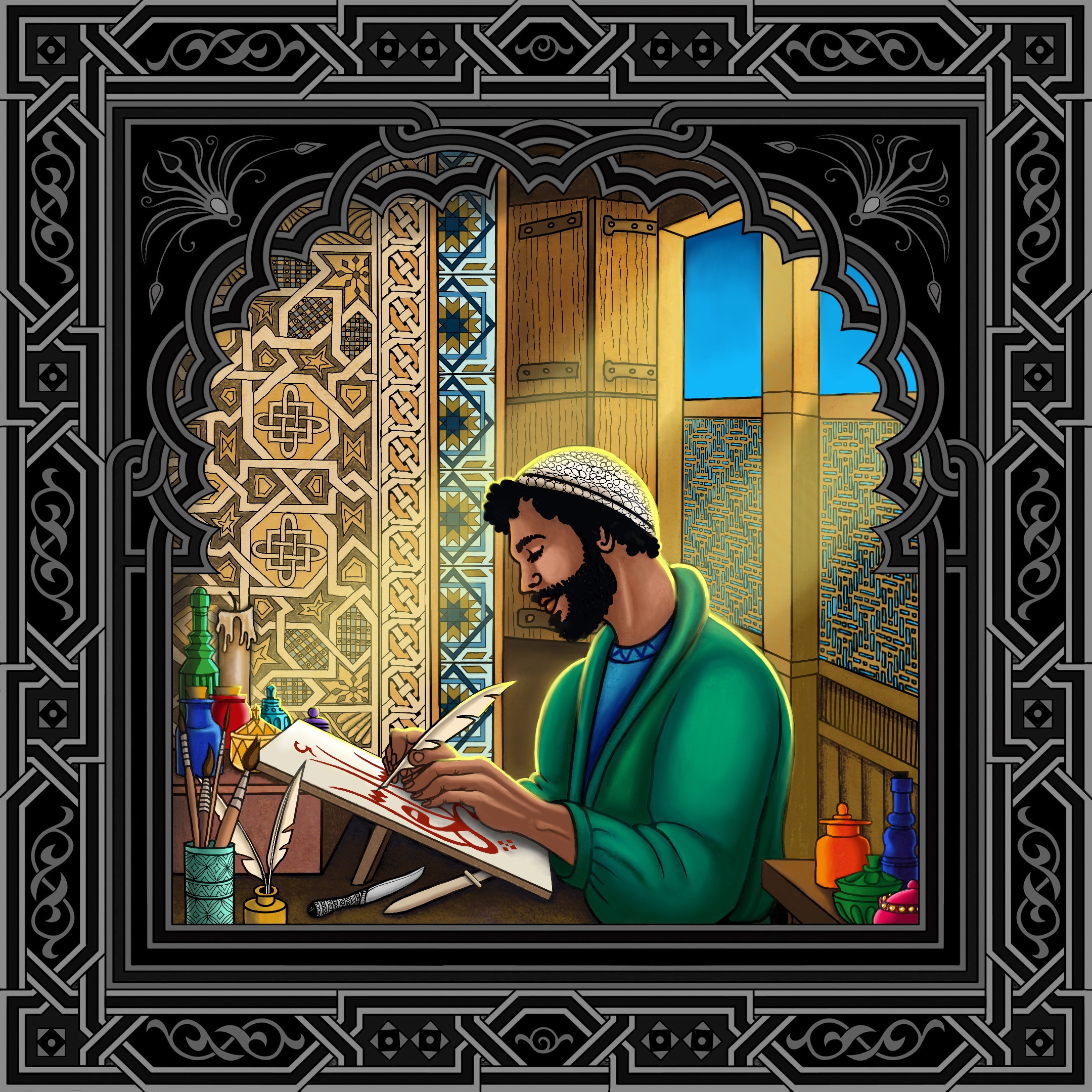
The late afternoon sun filtering in through the window painted everything golden. It glinted off the little glass pots in which Yusuf kept his pigments and inks, made the colors of the silk wall hangings glow, and made Yusuf himself look like—look like—
Nicolò was not good at similes. He couldn’t think of any comparison that really captured what the noble lines of Yusuf’s handsome face looked like to him in that moment.
He stretched out his feet under his crossed legs and straightened his back, stiff after a long day’s work. The pile of papers he had just finished ruling lay to one side, next to the mistarah he used for larger books where Yusuf planned for more elaborate decorations. The pages themselves looked all right, he thought, examining them critically. Say what one would about Nicolò, he knew how to draw a straight line. It seemed a small accomplishment in comparison with Yusuf’s work, but it was a necessary one. On his left sat a ream of untrimmed Samarqandi paper, claimed from a shipment of luxury papers at the market last week. Nicolò grabbed his penknife and went to work.
Work was always a worthwhile distraction from more useless feelings.
Seated in the corner with his writing desk, Yusuf looked up. “You finished the pages for the Shahnameh order already?”
Nicolò glanced back at his stack of ruled pages and nodded. “As you asked, two hundred pages, plus twenty with spaces for decoration. If you need more later, there’s still some left from that paper order.”
“Thank you,” said Yusuf with a smile. He had a fine smile, thought Nicolò, bright, the wrinkles around his eyes giving the expression good humor and the beard giving it a kind of majesty. No. No. He wasn’t thinking along these lines again. “What will you do with the Samarqandi paper?”
It took Nicolò a moment to realize he’d been asked a question. “Oh. I.” He cleared his throat. He was a professional, and Yusuf’s associate. He was not a schoolboy with a crush, to be caught out daydreaming about the object of his affections. Studying the paper, which was thick and smooth and a luxurious light violet color, he forced himself to evaluate it rationally. “It’s fine, but small. No more than ten lines per page, I think, or fifteen if you write in small letters. Perhaps for a short treatise, one a man could carry around in his pocket.”
Yusuf nodded. “I’ve had a couple of orders that might work for. Let me finish with al-Mufaḍḍaliyāt here and I’ll think about it.”
As he turned his head back to his work, giving Nicolò an unimpeded view of his profile, Nicolò bit his lip and thought of a comparison. As a young man, he had once seen the Roman murals in the church of San Vitale in Ravenna, noble portraits of the Emperor Justinian and Empress Theodora and their bishops and generals and attendants. Yusuf could have been drawn by the hands that made those mosaics, with the strong yet delicate straight line of his nose, and the luminous quality of his brown eyes.
Nicolò was becoming downright ridiculous. He picked up a sheet of paper and began to trim it.
The irony of it was, it made perfect sense for him to love Yusuf. After their first meeting, with all its—its horror, and violence, and shame, but also its mystery and wonder, Nicolò had never expected to see Yusuf again. He’d thought that meeting him was just one of those heavenly signs that appeared to people, like Saint Paul’s vision of a light brighter than the sun and of Christ that had convinced him to change the course of his life. A once-in-a-lifetime miracle, never to be repeated.
But when he’d seen Yusuf again, it had had been so ordinary and everyday, him looking for poultice ingredients, Yusuf looking for materials for making ink. So uneventful to anyone who might have witnessed it, and so monumental in Nicolò’s mind.
Because it had taken only a few cautious, strained meetings for Nicolò to see what he could never have seen in the battle on Jerusalem’s walls: that Yusuf was a deeply thoughtful man, and a learned and clever one, and a kind and good one. That Nicolò’s earlier wrath against him had been unjust, grounded in prejudice and a poor understanding of the world. That in every aspect, he was a man whom Nicolò could respect and whose friendship it would be an honor to cherish.
And Nicolò did cherish it. He did. He would be grateful every day for the rest of his life, however long that might be, that Yusuf had seemingly discovered things in him that were worthy of respect and affection, and that he had invited Nicolò to join him as he traveled far from his family’s home in Ifriqiya to open a branch of the family bookselling business in Bukhara. Unfortunately, whatever perverse little imp in Nicolò’s soul that so often turned his feelings of friendship into something unchaste and downright lustful had raised its troublesome head again.
Across the room, Yusuf bit his lower lip as he completed a tricky bit of calligraphy, and Nicolò accidentally drove his penknife into the heel of his hand.
He hissed in a sharp breath at the sudden shock of pain and gripped the wounded hand tightly, more to stop the drip of blood onto the paper than to stop the bleeding. Because the bleeding stopped on its own within seconds, the hand knitting itself back together before Nicolò’s eyes and leaving the skin whole and painless under a bright red smear of blood.
All the more reason for Nicolò to keep his lusts under control, he thought. Whatever divine mystery linked him and Yusuf together, it had not gone away, and how much more thoroughly could he debase a miraculous gift than by nurturing a schoolboy passion for the man with whom he shared it?
“Are you all right?”
He looked up to see Yusuf peering at him with concern.
“Fine,” he said, smiling at Yusuf sheepishly. “I wasn’t paying attention.” And then, because Yusuf was standing from his cushion, “No, no, you don’t have to—”
But it was too late. Yusuf had already risen and crossed the room to kneel by Nicolò and take the wounded hand between his own. He peered at it carefully and whistled, seemingly impressed at all the blood. “You really stabbed it in there, didn’t you?”
His face was really very close to Nicolò’s. Nicolò could feel the warmth of his breath. He flushed. “It was stupid.” A drop fell from his hand, and he noticed that the paper he’d been cutting bore several dark splotches of blood, the brownish color blooming against the violet. He groaned. “Oh, the Samarqandi paper! I’m so sorry. At least it’s only the one page!”
Yusuf scoffed dismissively. “Don’t be ridiculous, it’s a piece of paper. We can get more. Your hand’s more important.”
“And apparently we can get more of those as well.”
It was a weak joke, but Yusuf huffed out a laugh. “Apparently.”
He was still holding Nicolò’s hand, stroking a thumb across the place where the wound had been. His hands were warm and dry, the touch of his thumb soft as it moved over Nicolò’s wrist and the base of his palm.
What if he never let go of my hand? The thought popped unbidden into Nicolò’s mind. Better, what if he touched my face the way he’s touching my hand now?
As if Yusuf had heard his thoughts, he seemed to notice that Nicolò’s hand was still in his, and he dropped it quickly, giving Nicolò a smile that seemed just a little tight to Nicolò. “I beg your pardon,” he said. “I was distracted, thinking about…how strange it is.”
“The, uh….?” Nicolò couldn’t think of a word in Persian, Arabic, or Greek that encompassed the idea of “miraculous healing on a perfectly ordinary day with no angel to explain the meaning of this phenomenon,” so he simply lifted the once-wounded hand and wiggled his fingers.
Yusuf’s smile turned a little truer to Nicolò’s eyes. “Yes, the….” He wiggled his own fingers. “My father always taught me to be careful with the knife when cutting paper and pens to avoid exactly what you just did. But if you heal in an instant….” He shrugged. “I guess it doesn’t even matter. Even very ordinary things seem strange when you can’t be hurt.”
“Well,” Nicolò pointed out, “we can be hurt.” He rubbed the palm of his hand.
“You know what I meant.” His eyes narrowed on Nicolò’s hand. “Your hand is all right?”
Nicolò shrugged and stood. At least he had a reason now to move from sitting and gazing at Yusuf’s face all day. “My hand is fine, but still bloody. I need to go wash it off.”
“Right. Yes. Of course.” Yusuf stood, too, wiping his own hands together and seemingly shocked at the smears of blood left behind. “I’ll go with you. Can’t write like this.”
Their house was a rental owned a friend of Yusuf’s father, on a street in a well-to-do district surrounded by other houses their landlord rented out to foreign merchants. At the end of the street was a kariz, a little underground canal that came out in a fountain, and every morning ‘Uthmān Balkhi and his wife Safiyya, who worked for the landlord and took care of cooking and household maintenance, came to fill the cistern in the courtyard with water. Nicolò liked the courtyard very much. The house itself was very pleasant and well-maintained, but the courtyard felt like a little paradise to him, with its flowering gardens and the cistern, designed as an ornamental fountain.
As Yusuf stepped toward the fountain to wash his hands, the flowers framed him against the blue of the sky, the sun sparkling on the water, and Nicolò wished, not for the first time, that he had a talent for writing poetry.
Let Nature fashion flowers bright and gay
And let the sun its rays send down for light,
They’ll never craft a face that shines so bright—
God’s teeth, what a stinker. He’d repeated ‘bright’ twice, and the metaphor was unclear—was he comparing Yusuf to a flower or the sun?
Bah. He wasn’t supposed to be writing love poetry about his business partner and dearest friend, anyway. Not like this. He put the poem out of his mind and waited his turn to wash his hand at the fountain.
The woman stares ahead at the blue waves. Clouds loom on the horizon, but she doesn’t think the rain will hinder their journey. Not today, anyway.
“Getting impatient, are we?”
The woman turns to gaze into the eyes of her traveling companion. The other woman is beautiful—tendrils of long black hair escape from the scarf she’s tied it up in, framing a smooth, clever face smiling with amusement.
“You know me,” says the first woman, her voice warm with affection and knowing. The two of them have traveled so long together that they can anticipate each other’s moods, read each other’s expressions as easily as breathing.
“So eager to get wherever it is we’re going.” The woman’s smile fades a bit. “It will never be the same again, you know.”
“That would be true whether we made this trip or not.” The first woman reaches out to her companion and twines their fingers together. The other woman’s hand is warm and dry and surprisingly strong as she grips the hand of the woman she—she—
Their eyes meet, and the love in them is old and unshakeable as the earth.
Nicolò sat straight up in bed. The dream had felt so real, he’d thought he could taste the salt on the wind. But no, he was in the small room behind the kitchen that had been designated for him to sleep and store the trunk with his possessions. He felt himself with shaking hands, patting his chest, his arms. He was…himself, whatever that meant. Relief washed over him. As strange as his body had become to him, it would have been stranger still had he woken to find himself the woman from his dream.
He stood to look out the window, and sighed. The moon was still high in the sky. It would be hours still until the muezzin called the city’s Muslim inhabitants to pray Fajr. He supposed he could try praying matins. “"O God, come to my assistance; O Lord, make haste to help me,” he murmured under his breath.
It felt less like something recited by rote in the monastery and more like a genuine request for assistance, though assistance with what, he didn’t know. Going back to sleep, perhaps. He was unsettled by the dream, which hadn’t felt like a dream so much as a window into what it would be like to be another person.
More foolishness on his part. Probably he’d eaten too fast at supper, or the like.
In any event, he didn’t think he’d go back to sleep. His low mat on the floor, covered in blankets, didn’t hold much appeal to him at present.
Quietly, so as not to wake Yusuf, and with one hand on the wall to trace his path in the dark house, he went to the stairs at the end of the upstairs hallway and climbed to the roof. If he had to be awake, the fresh air and the sight of the stars would do him some good.
It was a great deal cooler than it had been during the day, and he breathed the chilled air in deeply. He liked its sharpness, which felt like it was cutting through the strangeness of his dream. Pulling a mat from the pile by the door, he sat on it and looked up at the night sky.
The stars were at odd angles here, compared to what he was familiar with. The constellations were familiar, but their locations just a little bit off. It was disorienting. He knew about the mobile sphere, and the rise and fall of constellations, and all that, but living for so long in the same place, he came to know the stars’ movement in time, not in space. Here, he could trace the line of stars marking the Serpent with his eyes and know that if he were to face the same direction at home, he’d be looking at—at what, the stars of Virgo, perhaps? He didn’t actually know how far Bukhara was from Genoa, so he couldn’t do the math to tell just what would appear in that region of the sky at home.
Nothing in the world was constant, he thought. Not even the stars. He shivered, feeling very alone.
It was at that moment that he heard the sound of footsteps. Nicolò turned to look over his shoulder.
He could barely make out Yusuf’s features in the pale light of the half-full moon, but it didn’t matter—no one else would be here at this time of night. “Hello,” he said softly, though if Yusuf were coming up here, the damage was already done. “I didn’t mean to wake you.”
“But you’re making so much noise,” said Yusuf in a dry, soft voice, before chuckling in a way that made Nicolò’s stomach flutter. “You didn’t wake me. What are you doing up here?”
He shrugged. The vast dome of the heavens felt smaller, now that Yusuf was here, more intimate. Like they were the only two men in the world. “Looking at the stars,” he said.
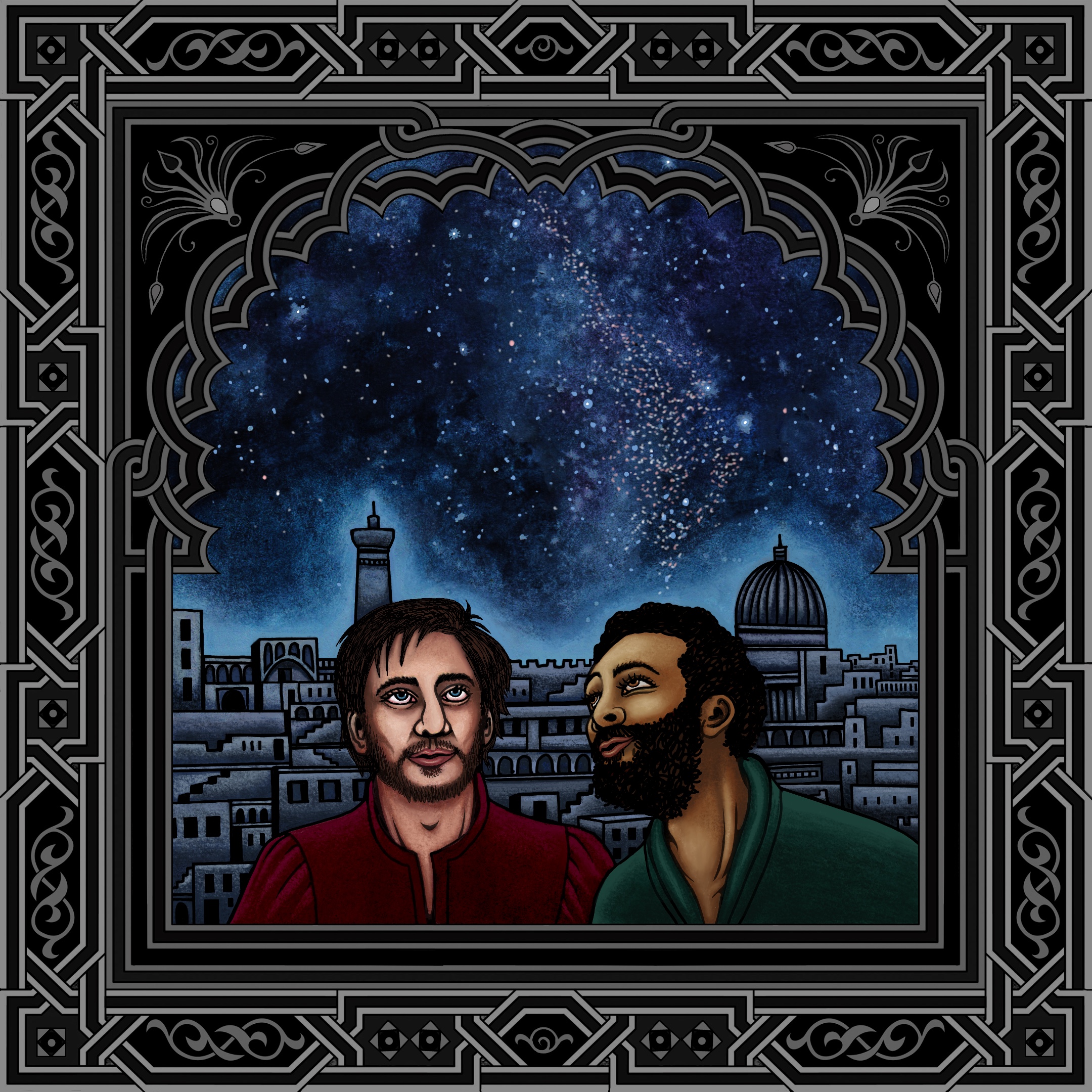
Yusuf nodded slowly. “It’s a beautiful night for it.” He pointed at the Serpent where Nicolò had been looking a minute ago. “ʿUnuq ul-Ḥayyah. It’s called the neck of the snake, but I always thought it looked like an eye. It’s practically staring through our windows.”
Nicolò didn’t have to know all the names of the stars in Arabic to know which one Yusuf was referring to—the big red one, Cor Serpentis, the heart. “An eye in the middle of the snake?”
“Perhaps it’s simply a snake with a very large head.”
Nicolò snorted out a laugh, and Yusuf grinned at him before pulling another mat from the pile and sitting beside him.
If Yusuf had wanted to speak, Nicolò would have tried to pull some words out and keep up his end of the conversation, but Yusuf seemed content to simply sit and gaze out at the stars, so Nicolò let himself relax.
They weren’t often this close together these days, so close they could touch. The house here was large enough that they didn’t need to share a room, much less a bed, and the last time they’d had to fight back-to-back was almost a year ago now, some two days’ travel outside of Isfahan when the caravan they’d been traveling with had been robbed. These days, they spent much of their time together, but separate, each heeding his own work in his own corner of the room.
But not now. Now Yusuf’s hand was on the roof only a scant inch or two from Nicolò’s. Nicolò could hear his breath, the way the slight breeze shifted the folds of his mantle.
When he and Yusuf had met, it had been with anger, and the shouting of men, and the clanging of swords. But when he had fallen and risen, and Yusuf had fallen and risen, the rest of the world had fallen away—there had only been him, and Yusuf, in a strange and deadly dance, each trying to kill the other so that he would stay dead. Nicolò had not known he was capable of such pain, or such violence. He fought on with a sense of unreality, unable to fathom what exactly what was happening but certain in his goal. Sometime, somehow, though, his soul had ceased to whisper My God-given purpose is to kill this man, and then I will die. It had begun to whisper, Nobody on earth knows this man’s body the way that I do. Nobody knows me the way he does.
A man was not supposed to know such things about a person he was trying to kill. He was not supposed to know about the way bruises darkened and faded on the thin skin of a man’s neck or wrists. He was not supposed to know how he twisted his mouth when awaking from death, as if it tasted sour on his tongue. He was not supposed to know the exact lines an enemy’s slender fingers formed when the breath of life returned to him and he gripped the hilt of a sword like it was the only thing that kept him from screaming.
This was not then. They had passed through that hell. They were friends now, business partners, neighbors. But Nicolò felt it again, sitting next to Yusuf in the dark: Nobody on earth knows this man’s body the way that I do. Nobody else would know the shape of him like this, even in the dim of the night. Nobody else understood how the starlight reflected in his eyes signified an undying light within.
Perhaps this knowledge was not meant for men in the typical sort of way. But it had been given to Nicolò nonetheless. Sitting next to Yusuf on this cool, quiet night, he could not regret or chide himself for the knowing that tied him and Yusuf together. He could only be grateful that this peace had been granted them, that the two of them could sit as friends, small against the backdrop of a large and mysterious universe but willing to face it together.