
Chapter Text
What the war tales of old never seem to mention, Edmund thinks, is just how utterly disgusting battle is.
The poets can polish their words all they want, but clearly none of them ever set foot—literally— inside a Giants disemboweled stomach. Warm blood spurts and steam curlicues from within the wide gashes that fell the creature. Edmund retches, bile rising in his throat, quickly hopping free of the gaping hole. He shakes off an intestine wrapped around his ankle, and hopes that the acid of the stomach won’t damage his armor. It probably will.
Below, the battle rages on. Edmund surveys the space next to the mountain: a few Giants loom out from the crags and in the game trails which allowed Caspian’s forces to take them by surprise. This holdout of Giants, a remnant from Caspian’s earlier war, had been wreaking havoc amongst the small shepherds and farmers of this region.
When Caspian left to bring them down once and for all, Edmund went with him. It wasn’t like Edmund needed to go, or felt he needed to whet his sword in blood, but Edmund hadn’t been out of the castle in a few years and the excuse was all he needed.
Far ahead, Edmund sees Caspian’s golden armor flash and shine in the dull sun. His sword glints like one of the jewels in his King’s crown. The king is holding his own well enough.
Edmund turns and watches as two nearby Narnians take turns poking at a Giant with their spears. The men hold their weapons securely, and make practiced aims. Unfortunately, Giants are over three meters tall, and their arm spans require a different set of skills.
Edmund picks his way down the mountain path, stepping gingerly over fallen Giants and the occasional comrade. They still haven’t found the instigator of this group, a Giant named Cr’ac, and Edmund has a hunch they’re close. Only, this group they’re fighting doesn’t contain the instigator, the coward.
He makes way to his allies, and brandishes his sword. The soldiers, noting Edmund’s presence, step back.
The Giant stares down at him with two doleful eyes.
“A myth come to life,” It croaks. “Edmund the Just.”
“That’s me,” Edmund says, and darts forward.
Giants are big. That’s their main accomplishment but, Aslan save them, they are slow. Edmund uses this knowledge to his advantage. He runs forward and holds his blade flat against his palm, ducking under the Giant’s arm and making a long scrape against its side. He has to brace his sword against his hand to make the cut, as Giants have tough, leathery skin. It’s probably the reason they don’t wear metal armor.
Edmund spins around as the Giant roars in pain. He grins. The cut on the Giant’s side bleeds profusely.
The Giant is incensed. It lumbers around to face him, turning its back on the two spearmen. Its eyes narrow and it brings its sword—dull, a bit rusty, but large—up for a slash Edmund can easily avoid.
Edmund watches the arc of the blade come down and tenses, ready to move. At the last second, he leaps aside, and the weight of the blade combined with the momentum of the swing causes the Giant to stumble forward. At that moment, the spearmen decide to take their stabs at its back.
The Giant makes no sound, through now it is bleeding from three wounds. Again it focuses on Edmund. Edmund keeps aware of his surroundings, too. There are three other skirmishes taking place nearby, but none will interfere with this battle. Edmund places his feet carefully, aware of the stones and brush that litter the battlefield.
The Giant raises its arm again, and Edmund is struck by the power that the Giant possesses. Such strength in the bicep, and the grip on its sword is firm and unyielding.
Edmund braces himself and dodges. He skids on the stone, and leaps forward to drive a thrust into the Giant's heart. The Giant deflects his blade with its arm, wounding itself in the process, but Edmund knows the end is near for this fellow.
The Giant raises its head and roars towards the sun. The tendons in its neck bulge. Edmund sees his chance. Now, a slice in the exposed neck.
“DAMN Y--!” It is cut off by the gurgle of its own blood frothing out of its mouth.
Edmund withdraws his sword, and is bathed in hot blood from the cut veins in the Giant’s neck. It brings its hands forward, dropping its heavy sword to the ground with a clang to clutch at its neck. It won’t be harming any of the rest of their party anytime soon, Edmund notes.
Edmund steps back and surveys the ground. The two spearmen nod their thanks and run to defeat the last skirmish.
Edmund watches them leave, aware that this battle is at its end. He looks down at the Giant he just killed, as the light drains from its piggish eyes. Slowly, the haze of battle lifts from his own eyes and ears. No longer do the shouts and grunts of battle plague him. The only thing he can smell is blood and sweat, the former from others and the latter his own. Blood trickles down his legs, going under his armor and soaking through the chainmail.
Edmund feels disgusting.
A horn blows and echoes on the cliffs. Edmund lifts his head and finds the source of it.
A little ways away and below, Caspian lowers the victory horn. Edmund smiles at the sight, at Narnia’s king posing victorious, ignoring the grime on Caspian’s armor and the blood tangled in his hair. Edmund always liked this version of Caspian, high off the surge of battle, more than the face Caspian presented to the court at home.
He leaves the Giants corpse behind and makes his way to where the rest of the soldiers are regrouping. He joins the fray at the outskirts, near a centaur who wordlessly offers him a rag.
Edmund murmurs his thanks, and wipes away the battle from his blade.
“Edmund!” A voice calls from the center of the crowd, at once warm and a little loud. Caspian.
Edmund sheaths his sword. The soldiers make way for their king, who strides up to Edmund.
Caspian grew into a handsome man of twenty-two, and looks every part the king he is. Now, even in his battle grime and trailed by an advisor, his grinning face belies a boyish charm that never quite went away. Ah, Narnia. His dark eyes are alight with the win and the heady high of battle-lust.
Caspian grasps Edmunds shoulders. “We are close, I can feel it. Cr’ac is near and must be hiding in a cave somewhere.”
Edmund can never quite meet Caspian’s eyes. They are too full of excitement too close after killing. Edmund thinks he will never feel as comfortable with death as Caspian does. Caspian’s armor blinds Edmund a little when the sun shines on it.
“Of course, I agree,” Edmund says, wriggling out of Caspian’s hands.
Caspian laughs and releases Edmund, far too jolly for the setting. All the dark cliffs and dull rocks only make Caspian shine brighter than the sun.
“We celebrate! And regroup,” Caspian adds this last order to a nearby soldier, who nods and rushes away.
“Walk with me?” Caspian asks, and Edmund, despite how dirty he is and how much he wants to sit down on the earth, cannot refuse.
They turn away from the scavenging and the aftermath, towards a little grove hidden in the mountain depths.
Caspians armor clinks beside him as they walk. Caspian is more than a few inches taller than Edmund, a fact that always irritated him. Even now, Edmund has to look up to see Caspian’s face.
“I miss home,” Caspian says, unexpectedly. They’ve only been gone a fortnight.
“So do I,” Edmund agrees. The ground beneath their feet changes from stones to a small cushion of grass.
“Cair Paravel? Or the land beyond?” Caspian asks.
Edmund pauses his steps but he doesn’t have to think about his answer. “Cair Paravel.”
“You’ve been here almost nine years, by our reckoning,” Caspian notes.
“A long time. But I don’t miss England. In fact, I hardly think about it,” Edmund admits.
Edmund can’t answer why Aslan or Narnia’s magic has kept them here this long. The last time, they were here for fifteen years. He supposes nine is a long time. Deep down, Edmund never wants to go back.
Leaving once was already hard enough.
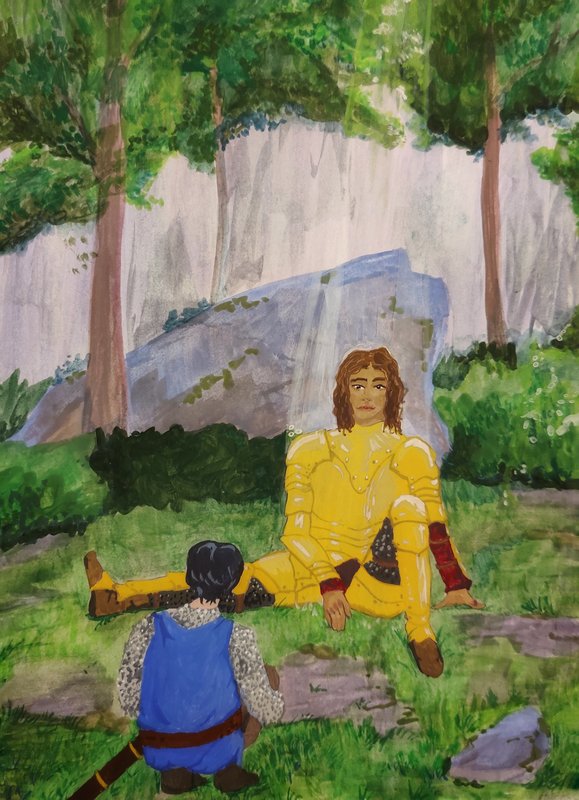
A loud clanking brings Edmund out of his thoughts. Caspian attempts sitting down, but all the armor tends to get in the way of such things. He looks perfectly disgruntled, like a thwarted cat, legs splayed out and half on his back. Edmund can’t help himself; he laughs.
“Don’t make fun of me!” Caspian says, but he’s laughing as well.
“Do you need assistance, your Majesty?” Edmund asks, easily crouching down because unlike some people, he doesn’t wear the full set of plated armor.
“No! I refuse,” Caspian says.
Edmund shakes his head, and in that moment the sun decides to break through the clouds and a perfect ray falls on Caspian’s head. Now here is what the poets all wrote about, Edmund thinks, and wishes with all his heart he could take a photograph of the sight. The sunlight illuminates every strand of Caspians hair, and darkens his eyes so Edmund can almost see his reflection in them. Edmund blinks, and the ray passes.
Caspian is looking at him funny, and Edmund averts his gaze. Sometimes, Caspian has perfected the powerful stare of a king. He isn’t like Peter, who when he was king only ever had love and strength in his eyes. No, Caspian’s gaze holds something deeper, and Edmund isn’t sure he wants to know what it is. It does not help that Caspian is not his brother, and is more beautiful than most of the people Edmund sees on a daily basis.
“I also can’t wait to go back,” Edmund rejoins the conversation. “I want to be with my library and the gardens. And Lucy waits for us.”
“Well, Cr’ac should do us a favor and come out,” Caspian says. “The honorable mice say that one last group of Giants hides in a cave only a day’s march away.”
“So by the day after tomorrow, this business will be done,” Edmund muses.
“Yes,” Caspian says.
Edmund nods.
Caspian sighs, looking down at his armor. “I think I will need your help getting up.”
*
A little ways away down the mountain trail, the camp is moved and tents erected for their force. The small army is less than 200 soldiers strong, but more than enough to defeat the remaining Giants.
Edmund rests in his own tent on a small cot laden with furs. He isn’t royalty, not anymore, but he is still an important guest, a myth come to life and a former king. The Narnians give them gifts and nice things, and treat them as sub-royalty. Edmund tried once, long ago, to protest that he should be treated the same as any other, but to no avail. Edmund can’t shake the feeling that he is out of place.
The air carries smoke from the campfires, and the low sounds of soldiers' activities passes through: a soft scraping from a whetstone, the pop of logs, the occasional murmur from a watchman.
Edmund tosses and turns in his cot. He’s already cleaned his armor and put on unstained pants. He ate some stew from the communal pot, so he isn’t hungry. The mountain air is not yet cold enough for a shirt, but he has a robe thrown over his shoulders.
Edmund supposes he could go bother Caspian, but the king needs his rest. Caspian should be resting. It’s his duty to inspire his soldiers, and he can’t do that if he’s half dead on his feet. Edmund thinks that sometimes in Caspian’s pursuit of a better Narnia, he neglects his own needs and desires.
Edmund gets up, and crawls to the opening of his tent. He pokes his head out and surveys the camp. In front of him, a fire burns low, tended to by a few centaurs. Above him, the familiar constellations shine and the half-shape of the moon is high. To his left, Caspian’s large tent is still lit from within. Edmund sighs when he sees the warm glow.
He fumbles his way out of the tent, grumbling when the tie of his robe gets tangled in the posts of the tent.
“Blast it,” Edmund curses, and shrugs out of the robe. It isn’t too cold outside anyways, and he can’t be indecent surrounded by centaurs, who never wear shirts as it is.
He gets up and paces across to Caspian's tent.
“Caspian?” He calls softly outside the entrance.
“A moment,” Caspian’s voice answers, and Edmund waits as the light from the tent comes brighter and brighter until the tent flap opens.
Caspian’s body shields the candle from the gust of air caused by the opening. Caspian himself looks ready for sleep. His hair is washed and brushed, his crown is gone, and he is dressed only in his tunic and soft trousers. Caspian’s eyes go wide at Edmund’s appearance.
“Are you alright?” Caspian says, before holding the flap open for him. “Come in.”
“I’m fine,” Edmund says. He rubs at his arms a bit, chilled from the brief walk over. Maybe he shouldn’t have left his robe.
Caspian sets down his candle on a small table and steps over to his own bed. It's an actual bed, with a mattress and frame and thick blankets, one of which Caspian swipes off and drapes around Edmund’s shoulders. Edmund finds it funny that the bed has been brought along on a campaign such as this, like Caspian will wilt if he doesn’t sleep on a cot like the rest of them.
“Thank you,” Edmund murmurs, hiding his annoyance at the gesture. He came here to ensure Caspian was caring for himself, not about him.
“You should be resting,” Caspian says, and Edmund wants to laugh. But Caspian’s face is withdrawn and concerned, and maybe a bit red from the cold.
“I could say the same to you, your Majesty.” Edmund tries to lighten the mood.
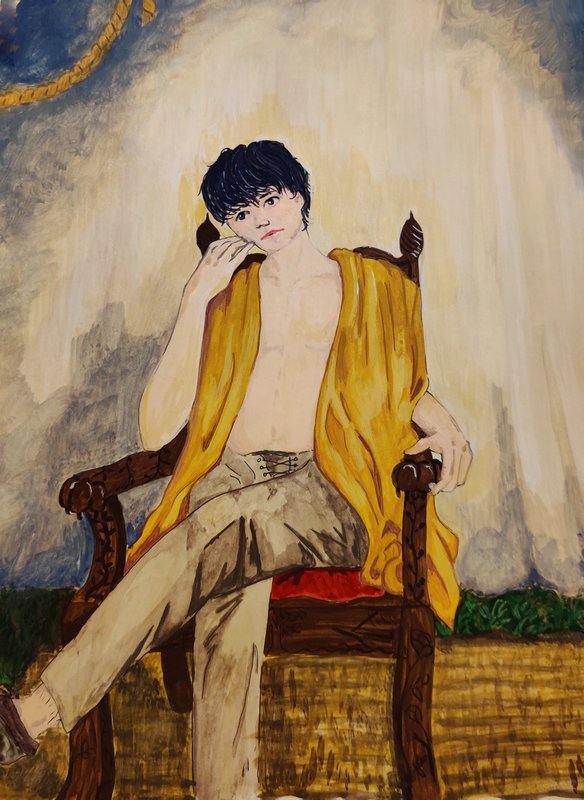
“I was about to,” Caspian says. He runs a hand through his hair, and gestures to the lone chair. “Have a seat.”
The chair looks like it has relatives who are thrones. It is an impressive feat of Narnian woodworking, dark and carved through with trees and birds. It even has a red velveteen cushion and armrests: a chair fit for a king. Edmund thinks that the only reason this chair is here is because the throne of Narnia is made of stone and thus, quite hard to move.
“I couldn’t possibly,” Edmund says, and takes a step forward. He’ll just sit on the floor.
“No, no, I insist,” Caspian says, a little loud and hasty. “I will sit elsewhere. You have had a long day.”
Edmund cautiously sits down. The cushion is soft, far softer than the pallet in his own tent, and he rests his elbows on the arms of the chair. His fingers trace the carvings at the ends of the arms. They are fashioned into lions paws. Aslan’s throne.
Caspian gingerly sits on his bed and faces him. There must be a draft on that side of the room, as Caspian’s cheeks still bear a bit of red. Even kings must bear the weather, Edmund thinks, and smirks.
Caspian isn’t looking at him, though. His eyes are trained to his hands, where they spin one of the golden rings adorning his fingers. Edmund rests his head against his hand. It took them over a fortnight just to travel here, first by sea then by river then finally by foot in the mountains. Edmund supposes it is the first night in a while that they have been able to sit together.
That isn’t to say things are any easier at Cair Paravel, where Caspian must reign and do his duties. But the yellowed candlelight and the stone surrounding them remind Edmund of Aslan’s Howe. Only here, there is little threat, and no otherworldly magic and no pain of the Stone Table.
“I couldn’t sleep,” Edmund admits, and this finally gets Caspian to look up.
“Is it the battle?” Caspian asks.
“No,” Edmund says. “I’m not sure what it is. I just couldn’t fall into it.”
“Perhaps you need to write something? Did you bring your notebook?” Caspian asks, ever concerned for him.
“Maybe, and yes,” Edmund answers. Today is not the day for writing. “I couldn’t sleep, so I came to see if you were. You need it more than I do.”
Caspian smiles. “I will be fine, Edmund.”
“You’re the king. You have to take into account these things.” I would know, Edmund thinks. He throws in a glare at Caspian, for good measure.
Caspian raises his hands. “Fine, I accept the wisdom of the ages.”
Edmund shifts in the chair. Something about this chair and the goldenrod-yellow blanket around him and Caspian’s slightly mussed hair makes a part of him yearn. Maybe he’s getting mixed up in his old memories of Aslan’s Howe, all those years ago, back when Edmund was still a child and Aslan walked among them. How loved they all felt then.
Edmund gets up to leave, and Caspian rises with him. “Go to sleep. And I’m taking this,” Edward shrugs the blanket around his shoulders.
“Of course,” Caspian murmurs. He leans around Edmund and gently pulls open the tent flap for him. “Goodnight Edmund.”
Edmund looks up into Caspian’s eyes and sees again something hidden in their depths. “Goodnight Caspian,” He says, and steps back into the shadowed blue shades of the night camp.
Edmund hears Caspian blow out the candle. Satisfied and slightly unsettled, he pads back over to his own tent and disentangles the robe from where he left it. The centaurs are standing, either sleeping or at parade rest, but Edmund leaves them where they are and crawls inside.
Edmund quickly falls asleep under the yellow of the blanket and into dreams where eyes like deep pools in the earth envelop him and hold him safe and tight.
*
“Wake up, Just Edmund!” A call from outside the tent wakes Edmund up.
Edmund rolls out of bed, rubbing the sleep from his eyes and pulling on his shirt. “I will be prepared shortly, thank you.” He calls out to whoever roused him.
There isn’t much for him to pack. The sack with his other essentials he will leave in the tent for the rearguard. He puts on his armor and buckles his sword around his hips. His eyes catch on the yellow blanket, so bright against the natural tones and the deep blue of the tent walls. Should he leave it there? On second thought, Edmund folds it nicely and stuffs it in the sack.
Everything else he leaves behind, and steps out of his tent into the bright world. The sun is out again today, and Edmund thinks it will be a pleasant march. He notes the Narnians collapsing Caspian’s tent, and looks around for the king.
“Where is Caspian?” Edmund snags the arm of a passing satyr.
“The king is with his counselors,” the Narnian tells him, pointing with a long arm before dashing away across impossible craigs in the rocks.
Edmund goes to where the vanguard of the army is no doubt making their plans for the days’ march.
Caspian only wears chain mail and a breastplate today. Both are gold, and contrast with a dark red half-cape. Caspian stands over a crate with maps laid out, and his advisors surround him. Edmund waits outside of their circle, opting to watch the camp being dismantled. It is no longer his place to advise in war.
Peter was always the one who was so battle-ready. Edmund truthfully never liked war. He has seen enough of it to be good at it, and he never considered that a thing to be proud of.
In the nine years Edmund and his siblings have spent here, Edmund feels like he’s finally come to stagnation. Peter went off to train Narnians and work at the king's request, Susan got married to one of the converted Telmarines and lives near Beruna, and Lucy remained at the castle with Edmund. Lucy could never stagnate, though. She was always caught in some project or running around with dryads at her heels. Even now, she holds court while Caspian is away, and the people love her for it.
But Edmund? He lives in the library and the gardens, and trains with his sword and sometimes talks to his sister and generally absorbs himself in words. When the Giants needed vanquishing and there was no one to be with Caspian, Edmund went. He wanted, no, needed to be needed somewhere.
So here he is, but he still feels like an accessory to battle.
Edmund brings his gaze back to Caspian. The man listens to his advisors well, all his focus trained on a general. Caspian is wearing a modified version of his crown: a circlet with a single cabochon ruby in the center. Edmund’s seen it before back in the castle. He has held the weight of it in his hands and felt the small inscribed leaves carved in the circlet, which are only visible when close.
Gold suits Caspian very well, Edmund thinks.
At that moment Caspian looks up, and meets his gaze. Edmund startles out of his thoughts. Caspian gives him a small smile before once again paying attention to the general. Edmund rubs at his neck, where the midmorning sun has already caused him to sweat.
The hairs there are getting long, Edmund notes. Unlike Peter and Caspian, Edmund could never deal with the kingly length of hair. So he has kept it cropped short. It’s all the better if he can feel the wind at his neck.
The advisors are rolling up the maps and storing them in oiled canisters, and Caspian waves for Edmund.
“You don’t need to wait there, you know. You’re Edmund the Just of Narnia, surely no one would disrespect your input,” Caspian tells him gently.
“It is no longer my place,” Edmund says. This is not the first time Caspian and him have had this discussion.
“I don’t need you to contribute anything. It is good to have you by my side,” Caspian says. His words are quiet, and Edmund has to strain to hear them. Caspian is usually louder than this.
Edmund pauses. “Are we moving out?”
“Yes,” Caspian says. “In the afternoon we will be in another little valley to set up camp, and then tomorrow we only have a short march to the caves where Cr’ac hides with his remaining supporters.”
Caspian waves at an aide over his shoulders, and they run off to blow a horn.
“Why not go to the caves today?” Edmund asks, though he thinks it is because of scouting reasons.
“The generals are considering the risk that the honorable mice will take to scout the caves for us. So we will wait. Are you that impatient, Edmund?” Caspian says this with a smirk, his teeth flashing white against the tan of his skin.
“Impatient? To get home, yes,” Edmund brushes him off.
“My liege! We are ready to march,” A centaur clops up to them.
Caspian turns away from Edmund, and it is as though his kingly visage slides on like a mask as he addresses his subjects.
“I am also ready, Sir Fluer.” He steps forward and cups his hands around his mouth. “Narnia, let us march!” Caspian bellows. An assortment of cheers resounds from the hubbub of camp.
Quickly Caspian is surrounded by guards and scouts and his generals, and Edmund fades away into the background and lets Narnia’s king do his job.
*
That night is more tense than the last. The men prepare for tomorrow's battle, but the mood is not somber. Campfires blaze. There is no need for them to hide, and somewhere a few satyrs are playing the pipes. Edmund hums along to the tune, an old Narnian song about a dryad and a satyr falling in love.
Today is a day for writing. Edmund sits on a cool stone outside his tent, his notebook open on his lap and his inkpot resting at his feet. Edmund misses the easy pencils of England, but he’s thankful for the resources to be able to write at all.
Writing is the only thing Edmund has to make sense of his role in the new Narnia. He’s heard the odes to the kings and queens of old, and seen artworks of himself in old books, but curiously, none of them mention the story in its entirety.
Not that Edmund wants to mention his betrayal, but part of him burns inside with the knowledge that there is more than simply the Golden Age. Narnians admire him, and call him Just, but Edmund hates that he still struggles to accept the title. At least in the Golden Age he felt he had earned it.
Edmund was never one for writing prose before he came to Narnia. Now, however, he finds a quiet appreciation of the art. Some lines about the sunlight on the king's crown, and fields of wheat messily adorn the page. Edmund sighs. Sometimes the words just don’t come. Edmund has to admit he never had any special talent in writing.
Again to his left Caspian’s tent is warm-lit, and Edmund knows Caspian speaks inside with his foremost counselor, Pierrig.
Edmund stoppers his ink and closes his notebook, tucking them inside his tent. Maybe he will go join the satyrs and dance for a while. Even the march today was leisurely, and did not tire him out. As he stands, the flap of Caspian’s tent opens and Counselor Pierrig steps out. He exchanges a few words with Caspian, who stands just inside, and leaves.
Caspian notices Edward and calls to him:
“Edmund! Are you resting?” There is a hint of a jest in Caspian’s tone.
“Of course not, my liege,” Edmund replies. “I intend to wear my shoes through with dancing.”
“Do you really?” Caspian ducks back inside his tent. The light inside goes out, and he reemerges with a smile on his face. “With the satyrs? You? You never dance.”
“I never dance at the balls,” Edmund specifies. It’s true; as soon as Edmund turned sixteen and the Cair Paravel dancing halls opened to him, he refused every occasion and invitation to dance.
“Too many people?” Caspian inquires as they stroll towards the sound of the pipes.
“Too many eyes. And I forget the dances, now. I never danced much back then, either.” Edmund says.
Caspian hums. “I’m surprised you remember the satyr’s footsteps, then.”
“I don’t know if I remember them,” Edmund admits, “it’s likely they changed. But they are easy to pick up, and the satyrs aren’t ladies of the court. They won’t flay me for messing up.”
They come to the bonfire where the pipes play loud and clever. A small drum beats the time, held securely in the hands of a Badger. A circle of satyrs spin around in a very simple, loose waltz, if the frenzied circle can be called that.
The Narnians notice their king, but they do not stop and bow for him. That sort of behavior is for the castle, not the road to battle. A satyr approaches them, though.
“My liege, and Just Edmund, we are honored,” he says. The roan ears atop his curly hair flicker.
“Is it alright if I dance? I was feeling a bit…” Edmund trails off. He takes a breath. “I miss it.”
“Of course!” The satyr bows, and toes over to the musicians.
Edmund smiles. He turns to Caspian, looking up into the king of Narnia’s eyes. “Are you going to dance?”
Caspian opens his mouth like a fish, but can’t seem to find his words for a moment. Edmund cannot recall the last time he saw him this flustered. Edmund tucks away the sight into a dark corner of his mind, so he might recall it later.
“No, no, I think—I think not,” Caspian manages after a moment.
“Alright, your majesty,” Edmund says, and as the song dies down he takes his place amongst the dancers. Out of the corner of his eye, he spies Caspian taking a seat on a log that a kind soldier has rolled out for him.
The pipes begin a high, bouncy tune. The steps are generally the same, and Edmund is able to fall into line with only a few mistakes. The satyrs are all around his height or shorter, as is their nature, and gaily he and them spin and make merry.
Four songs go by, and Edmund bows out, citing his need for a rest and a drink. He stumbles over to Caspian. Edmund feels on top of the world, breathing a little heavy and the hair on his neck is sticking up and he knows he must be a little flushed between the heat from the fire and the chill in the air.
“I think I’m done,” he says as he collapses on the ground next to Caspian. “My stamina is better suited for fighting, I think.”
“You lasted far longer than I could,” Caspian says, peering down at Edmund from his stump of a throne.
Edmund waves a hand at him. A mouse presented him with a goblet, and he’s too busy sipping the mead inside to reply.
“Ah,” Edmund swallows. He eyes the mead, all golden with a bit of red. “That’s good stuff. Perhaps too good. Between this and the dancing, I might finally sleep well.”
“Has sleep eluded you this whole journey?” Caspian’s tone is suddenly full of concern. His brows are pinched together.
“No! No,” Edmund protests. “Just this night and the last.”
Caspian looks only half assured.
“It is probably the battle,” Edmund says, and puts down the goblet while he’s at it.
“It will be done tomorrow,” Caspian says it like a promise.
Edmund nods. His heart is no longer thudding against his chest, and if he stays out much longer he knows he will be pulled into another dance.
“Hold this,” He says to Caspian, and places the goblet in Caspian's unquestioning, outstretched hand. Edmund gets up.
“What am I supposed to do with it?” Caspian says, looking puzzled.
“I am going to bed, so don’t let it go to waste,” Edmund says over his shoulder as he leaves.
Behind him, Caspian stares at the goblet like it is made of gold.
*
A horn in the night wakes Edmund. His mind is instantly on alert. It cannot be an ambush, because of their scouts. But likely Cr’ac took his chances in the night, like many evil creatures do.
Edmung throws on his chainmail and belts his sword.
The moment he is outside he can tell what is happening. Cr’ac decided to bring the battle to them, as it would raise the morale of his remaining troops and ensure they would not be cornered in the caves. To Edmund’s right no more than a dozen Giants battle small groups of Narnians.
Edmund searches for Caspian, but he cannot tell if the king is at the front or not. Edmund knows that other people will take care of their king, so he runs to join the fray instead.
Already the Giants are bleeding and roaring their displeasure. They are outnumbered more than ten to one, and Edmund feels like his presence is not necessary to end them.
But none of the Giants are Cr’ac, who is purported to wear a long sheepskin cape. Where is Caspian?
“Past them to the caves!” A soldier shouts to him, pointing with his sword.
Edmund runs as fast as his feet can take him, past earth-shuddering fights with the Giants and up the foot of the mountain. A group is already halfway up the hill, and Edmund spots the gold armor of Caspian with a sigh of relief.
When he finally catches up to them, it is right before the maw of the cave. Not even the moonlight shines inside.
All of Caspian’s party carries torches, and a few scouts come forward.
“First the scouts, then the honorable cantuars, then the king, and then the rear,” The general shouts.
“Caspian, I am here,” Edmund comes to Caspian’s side.
“Edmund,” Caspian grabs his shoulder. “Thank Aslan.”
“You can’t lose me yet,” Edmund says with a smirk.
Caspian sighs out.
“I will go with the vanguard,” Edmund volunteers. His blood is up from missing the fighting before.
The general nods at him, and Edmund purposefully misses Caspian’s opened mouth, prepared to protest.
Edmund takes his place with an odd mix of Narnians and old Telmarines. They are all the best fighters, the most accomplished and swift. None are particularly large, and most carry spears. Edmund accepts a torch from a nearby soldier, and steps forward to the mouth of the cave.
He inhales. And ventures into the darkness.
Edmund doesn’t feel fear in the cave. He’s been too long around and under stone to feel afraid of caves themselves. The torchlight creates beating shadows across the stone walls and illuminates the path forward. He can feel the reverberations in his feet from the centaurs hooves. The path is too narrow to not see anyone coming their way.
Edmund assumes there will be a larger cavern up ahead, and there they will find the cowardly Cr’ac. Indeed, as the party presses forward, the path opens up into a cavern that stretches up. But Edmund is only focused on the Giant waiting to meet them in the center. He unsheathes his sword. Beside him, his allies do the same.
Cr’ac is dressed in the sheepskin cape and no armor. In its left hand is a shield as tall as a man, made with lacerated boards of wood. In its right hand Cr’ac bears a sword far finer than any of the other Giants. Its blade is wide and sharp.
“So the king has come,” Cr’ac addresses him.
“I am not the king,” Edmund clarifies, and leaps right into battle.
Cr’ac is not unprepared, however. He parries Edmund’s first swing, and the strength behind the blade Edmund cannot hold to. Edmund swivels to the side, releasing the parry and just managing to not stumble back.
A soldier to the side takes his place, swiping at Cr’ac’s legs with his longspear. There is not much space in the cavern to fight. Swipes from Cr’ac’s sword must be dodged by all. Edmund has to admit it's a clever strategy; the Giant can slowly wear down all of them and avoid a rush by their full force.
The cantuars will not do well here, and Edmund notes they have instead moved to the rear. The cavern goes farther back, and has another tunnel, but it is too small for the likes of a Giant like Cr’ac.
“Come at me, Just King of Narnia,” Cr’ac bellows, swiping around with his blade as he swings back to face Edmund.
“I am the king,” Caspian’s voice comes from behind the Giant.
Cr’ac is careful to keep his eyes on Edmund as he acknowledges Caspian. “I see a king in front of me, so one of yous is lying.”
“I am not a king,” Edmund repeats himself. Cr’ac only smiles, and it is horrifying.
Caspian chooses this moment to attempt a backstab. Cr’ac notices in time, however, and swings out his sword in a clean arc as he turns to meet Caspian’s blade. Edmund skips back to avoid the blade, but his back scrapes the wall sooner than he thought.
It happens almost like time has slowed to a jelly-like consistency. Edmund watches the tip of the blade, silver and pointed like an arrow, slice across the tendon of his left thigh. It is right below where his chainmail ends, and like an idiot Edmund never wears full armor.
It hurts so badly, but even as blood spurts from it and his leg crumbles, Edmund lets loose only a small grunt of pain. He has been wounded in battle before; he knows he will survive this cut. But Edmund isn’t sure he will survive Caspian’s glare of rage, seen through the Giant’s legs as the king parries and engages with the Giant.
Another soldier has run over to him and tied a knot around his leg, but Edmund can only focus on Caspian’s battle.
Cr’ac proves himself to be an able fighter. Not the best, but his size makes up for lack of the finer points of swordsmanship. The soldiers also in the cavern make blunt passes at the Giant, and eventually Caspian lands a hit on the Giant’s arm.
They are good at keeping its attention away from Edmund, who is now mostly dead meat against such a foe. What a fight, Edmund thinks to himself and grits his teeth against the pain.
Behind Caspian, Edmund can see the centaurs preparing their bows. So that’s how it’ll be. This is not meant to be an honorable fight. It was never one to begin with, Edmund knows, because a duel against a person who has hid while their people fight their battles is a coward, and there is no glory in besting cowards.
Edmund cannot keep his focus on the centaurs, though, as they are half in-shadow from the mouth of the cavern opening. Instead his eyes track golden Caspian, who still shouts and bravely blocks the Giant’s swipes.
Caspian fights double-handed, and thus has more power to withstand the parry of Cr’ac. He breaks a hold, and in a clever feint scores a hit one Cr’ac’s side. The Giant roars.
In that moment, the thrum of a bowstring hums and a solid shaft of dark wood embeds itself in what Edmund assumes is the socket of Cr’acs eye. Edmund can see the arrowhead poking out the back of the Giant’s head. It is near-instant, the Giant’s death. Caspian steps back, and the cavern holds their breath as first the shield, then the sword, then the body of Cr’ac thuds to the cavern floor.
Caspian marches forward and buries his sword in Cr’ac’s heart. “It is done,” he announces. He looks up.
For the first time, Edmund thinks Caspian has noticed his injuries. Caspian practically runs to him, kneeling down by his side and taking his hand.
“Edmund! How--” Caspian gasps, and the shock and concern twists his normally kind face into a mask of worry.
The centaurs have entered the cavern. One of them looms over them, and Edmund’s getting a little fuzzy, but as he closes his eyes he feels that they will care for him well.
*
Edmund keeps rising to different circumstances. He blinks. He is still in the cave, but now on a blanket and, as he shimmies up onto his elbows, he can see his leg is bandaged. It still throbs, but not as much as before.
“Edmund! You awake!”
Edmund turns his head to his name called, and sees Caspian hurrying over to him. Caspian kneels by his side, concern written all over his browned features.
“How are you feeling?” Caspian asks.
“Um,” Edmund pauses, “Like I got sliced. ‘S my fault.” He waves a hand in explanation. “The wall. Help me up.”
“Should you be doing that?”
Edmund glares at him. “It’s not my first wound. It will heal, and it won’t hurt me too bad to walk on it.”
Caspian bows his head, and together they get him up.
It does not pain him overly much to stand, and Edmund suspects they have given him some draught to chase the pain away. He takes a cautious step forward, and finds the leg holds. He won’t be walking all the way back to Cair Paravel, but he can get out of this cavern and its other occupant: the corpse of Cr’ac.
“Did you look down the other chamber?” Edmund is curious where the other tunnel leads.
“No, you’ve only been out less than an hour.” Caspian’s hands hover near Edmund’s elbows as they take the slow, limping steps that Edmund’s new wound requires. Edmund only allows Caspian into his space because until Edmund reaches a wall, a badly placed stone could fell him.
Edmund concentrates towards that tunnel now. He feels that there is something there. If Cr’ac could not fit down that tunnel, why choose this cavern? Another Giant could have reported something to him.
Edmund stands in front of the other tunnel. He looks at Caspian.
“You will have to be my torch-bearer,” Edmund says.
Caspian looks caught between insisting that Edmund needs help walking, and also being the one to guide him. Eventually, common sense wins out, and he fetches a lit torch from one of the soldiers.
The tunnel winds at a leisurely angle down, just enough that they must go even slower to be sure Edmund doesn’t fall. Edmund would admit defeat, but he’s started this journey now and he’d be a wuss if he didn’t finish it.
His hand is steady on the wall, a support he knows he needs. It lets him feel the cool, grainy texture of the cave walls. The stone here could be gray or brown, but in the light of the flame it only appears tawny. Edmund watches the stone pass beneath his fingers, not quite willing to make conversation with Caspian. If the silence is awkward, neither remark on it.
It is Edmund’s stone-watching that shows him the reason why Cr’ac chose this cave for its final stand. A thin trail of red paint rises up from the floor, and begins to branch into rudimentary stalks and leaves.
Edmud glances over at Caspian’s side, and finds the motif repeated. Caspian holds the torch a little higher, and in front of them a darkness opens up.
“There must be a mural there,” Edmund hopes. A Narnian cave-painting from many thousands of years ago, maybe.
Caspian says nothing.
When they reach the cavern, Caspian places the torch on the ground, and as the light settles they can see what is there. The cave ends in a small, room-like cavern, only the ceiling of it reaches up higher than their light can. Every surface of it is covered in red and ochre and black paintings.
Edmund gasps softly. He limps forward to the closest one. It is a drawing of a satyr walking alone in a forest. The creature wears a red scarf, and Edmund feels his heart rise in his throat. He looks up and over, and sees a very familiar story drawn out. There, like a black gash in the cave wall is the Lamppost, and the White witch, and Aslan.
And them, of course. Fair-haired Peter and a beautiful Susan, smiling Lucy and himself, rendered with a slightly too large a nose and taller than Susan, for some reason.
The story ends with their reign, and them sitting on the throne, and maybe some illusions to their escapades in the Golden Age. But Edmund is drawn to the image of them on their thrones. The artist did not put the crowns on their heads, but rather drew the ochre circles outwards, like Medieval halos. They look regal, and certainly more legend than truth.
“This is quite beautiful,” Caspian says.
“It must have been made at some point during the occupation,” Edmund muses. His eyes, drawn like Narcissus to the pond, cannot leave his own painted visage.
Edmund turns and hobbles away so he can sit on the floor and not crane his neck so much to admire the paintings. Caspian remains standing.
From here, Edmund can watch Caspian too. The king traces his hand along the paint, following the story in order, taking careful time with each illustration. Edmund thinks he sees tears well up in Caspian’s eyes when Aslan is taken to the Stone Table. When Caspian reaches the High Kings and Queens, he too pauses.
He looks at the painting of Edmund, and then back at the flesh and blood King of old sitting wounded behind him.
“They did a fine job, whoever drew these,” Caspian says.
“My nose is too big, and I’m taller than Susan, so not fine enough,” Edmund huffs. He’s not really mad.
Caspian chuckles. “I don’t know. I think you look quite regal.”
Caspian shifts back to the mural. His finger traces the circle of each of their halos, stopping at the apex of Edmund’s.
“It is still so hard to realize that they aren’t just stories of old,” Caspian admits.
Edmund has no reply, so he waits.
Caspian continues, “I always figured that the High King and the queens were just, you know, maybe real people, and were so embellished over time they would be unrecognizable. It seems like they did so much in so little time and everyone loved them. I still feel tremors under my feet when I see all four of you together in a room. I can’t believe you are real.”
He looks over his shoulder at Edmund. “What is my history and legend is your lived experiences.”
Edmund nods. “I’m sure there are some stories that are embellished or just plain false. I mean, we have been gone for a thousand years.”
“True,” Caspian says. His finger traces the halo around Edmund’s painted face again. He takes a breath. “I must confess, you are my favorite.”
“In the stories?” Edmund thinks aloud.
“In real life.”
Caspian’s hand leaves the halo behind as he twists back to face Edmund. His gaze again holds that searing deep something. Every other time that gaze has lit only on Edmund, and all of Caspian’s words to him slide that something into place like iron puzzle pieces. Tight, and unlikely to let go. In the firelight Edmund thinks, oh.
Oh.
Edmund has jumped to conclusions before. He’s made bad choices. Quick, what choice can he make now that will not ruin anything. Run, Edmund.
“I’d better be. I’m the best sibling,” Edmund jokes, and carefully gets up. The moment passes.
Caspian shakes his head, smiling, and picks up the torch.
The walk back to the cavern is quiet, and once they reach it Caspian informs his counselors of the cave’s importance. Edmund grows rapidly tired, and his legs give out beneath him as they walk back to the camp. A centaur offers to carry him, and slowly the distance between Edmund and Caspian grows.
Back at camp, there is singing and dancing and drinking, but Edmund asks to be left alone. His leg throbs, and he lays in his tent not even listening to the sounds of the revel outside. It will soon be morning, but they will not move yet.
Edmund grasps a blanket around himself, shivering a little, more from the pain than the cold. His fingers grip the thick wool, and it is only then he notices it is Caspian’s blanket that is laid over him. Thick, and warm, and with golden tones, just like its owner. Edmund can’t bear it. He draws the blanket over his head like a child.
It is too much to even think about. Edmund is scared to even voice what he thinks, and it is that, what he thinks (he doesn’t even know! Part of him cries. But in his heart of hearts, he knows.) and even so, Edmund's brain is raising the scaffolding of a thousand protests. He needs to get back to Cair Paravel, and to Lucy, the only soul he’d trust with a secret like this.
He can’t hide from it forever. But he can try.