
Chapter Text
Sokka is running.
Or—no. Sliding. His feet don’t quite lift from the ice, boots skimming from slick blue to powdery white, breath tearing out of him in short, bright bursts. He’s small. So small that the world still feels large—that distance stretches instead of compressing—that chasing someone doesn’t yet carry panic with it.
The cold doesn’t hurt his chubby cheeks, just barely able to contain his smile because—
“Mom,” he calls out and in front of him his mother laughs, her smile mirroring his own as she dances backwards away from his grasping hands.
Her parka is bright against the snow, the fur at her hood rimed with frost, obscuring everything but her smile, the rest of her face smudged out—and Sokka runs because this is what you do when someone you love is moving away from you: you run fast enough to catch up.
To hold their hands in yours. To hug them. To tell them just how much they mean to you—to plead: please don't leave me behind—
His legs burn pleasantly. His lungs don’t hurt yet. But she only moves further and further from his grasp.
She had been right here a second ago and now, now she is so far away—
“Mom—!”
The scream fogs the air and disappears.
The ice fractures underfoot. Cracking—changing. Grooves appear where smoothness was, knots in wood instead of cracks in ice. The smell of salt replacing snow so fast it makes his head spin.
He’s still running.
Taller now. Legs eating up more distance underneath him. Breath heavier. The dock stretches forward in a way that feels unfair, disappearing into the horizon. A boat sits unmoored at the end of the dock, her sail unfurled.
His father and Bato walk ahead, silhouettes cut sharp against a pale sky, unhurried in their pace except Sokka can't catch up—
“Dad! Bato!” he cries out, gasping for breath—
His father lifts a hand—an acknowledgment—I hear you—and a dismissal all at once, because he just keeps moving forward. Bato turns his head just enough to check the distance between them, measuring— always measuring, calculating—before tuning away as well, climbing the gangplank up to the ship.
Sokka runs harder.
The boards beneath his feet creak now, the dock slick with frost, and the sea yawns open on either side of him, black and endless. The ships rock gently, patient, waiting. He is almost there—close enough to see the lines at the corners of his father’s eyes as he stands on the deck, the scar along Bato’s jaw—
And then the dock is gone.
The ship creak. Ropes groan. The water below churns, reaches up, grasps him—
The ground is solid again, warm beneath his feet, packed dirt and stone. The earth stretches before him now, and that stretching distance, that sense of being just behind—always just behind—is strong enough to choke on.
Katara is ahead of him now, hair whipping as she moves, water streaming behind her—after her—rising and falling at her command. Aang is at her side, light as a leaf, laughing as he bounds forward, barely touching the ground. Toph stands just ahead of them, a fixed point.
“Sokka!” Katara calls, glancing back. “Come on!”
He tries. Spirits, he tries.
But the space between them doesn’t close. Every step forward feels like two steps sideways—like Toph or Aang is redirecting the earth beneath his feet. He opens his mouth, to yell, to make a joke—something self-deprecating, something reassuring, something that says I’m fine, really—
He opens his mouth.
Nothing comes out.
His legs feel heavy now. Every step sinks, the ground is pulling him under as his companions—his friends—become specks on the horizon. He pushes harder. Tries to catch up. Tries—
A hand snaps shut around his wrist.
He stumbles, stops short as he is pulled from the mud and placed in a lap, Katara bundled up and soundly asleep beside him, fire blazing in front of him.
A hand grasps his own and points it up. And Sokka follows the lines, catches sight of Bato's smile, his father draped over Bato's back, feels his mother’s fingers carding though his hair—
The stars are blazing: their constelations—the jackalope running, the spearman takes aim—so close that if he just could reach out a little further he could hold them in his hand.
“The world is wide, little Wolf” Bato says, his voice echoing slightly, like it’s coming from very far away and very close at the same time. “And the water doesn’t care how brave you are.”
He gestures, tracing a path through the stars with one finger. Resting finally at the northern star.
“But light can guide you,” he continues. “Even when the way forward is dangerous. Even when you can’t see the shore.”
The stars shift, subtly, aligning into a single bright trail stretching across the sky, reflected faintly on dark water below.
“And sometimes,” Bato says, quieter now, “the light that guides you is not where you expect it to be.”
The sky flickers.
One star burns brighter than the rest—flares, brilliant and sudden—and then falls, streaking downward in a silent arc.
The dream tilts.
Sokka is sitting, knees drawn up, the fire low and guttering before him. The air is heavy, thick with smoke and salt and something sour beneath it all (the smell of singed flesh, of burning flesh). Across from him, his father sits hunched, shoulders bowed in a way Sokka has never seen before, the weight of grief draped over him compressing him down—reduced from a blazing northern star to just another man.
Katara lays next to their dad, bundled up and pressed into his side, the firelight reflecting across her tear stained cheeks.
Beside Sokka, Bato’s mouth twists—and for the first time Sokka sees him helpless. His eyes reflect the firelight, and in them Sokka sees the same loss mirrored back at him, doubled, shared.
***
A star falls in Shu Jing too.
It screams through the sky and buries itself in a farmer’s field just outside the village, fire blooming outward, easily quenched by Aang, Katara, and Toph.
Sokka is useless.
Again.
***
The room is too big.
It's not palace-big. Not when, in the past year, he has stood in the grand palaces of Anga Qel’a and Ba Sing Se, and—it's just…too big of a room for him—right now.
Too much empty space. Too much clean air. Too much light streaming in from the open windows.
Too many places for him to stand and plead his case.
(Too many places to be found lacking.)
Sokka stops just inside the threshold.
Where is he supposed to stand?
Closer looks desperate. Farther looks disrespectful. Somewhere in the middle looks maybe then? But that would be a guess—and guessing wrong feels worse than just standing in the threshold in all honesty. His boots sound loud against the polished wood. He has a sudden, irrational certainty that they’re leaving marks. That someone will notice in a second and politely ask him to step outside while they clean up what he’s tracked in.
He doesn’t move.
Indecision means he just…stands there.
The windows are open, the mountains filling might as well have been painted by one of the grandmasters he has seen in Ba Sing Se, the way the blue gray peaks are layered against the sky, mist clinging to their shoulders. Wind drifts freely through the space, stirring hanging scrolls, setting bamboo chimes murmuring somewhere outside.
Everything that belongs here breathes easily.
Sokka does not.
His chest feels tight, shallow, nerves crawling their way now his throat and into his stomach.
At the far end of the room, the man he hopes is Piandao stands with his back turned, brush moving across parchment in smooth, unhurried strokes. Sokka has spent hours with a brush and paper—scribbling plans, diagrams, half-formed ideas, trying to wrestle order out of the constant noise in his head. He’s never thought of the sound as anything but calming.
He has never thought before now that the sound could be oppressive. But it is.
…He’s been standing here for a while, hasn’t he?
His fingers curl into fists before he realizes it. He forces them behind his back, nails biting into his palms, grounding himself with pain because breathing doesn’t seem to be doing the job. He steps forward, clears his throat.
“Master—” The word leaves his mouth wrong, not strong enough—the two syllables swallowed by the open space almost as soon as they leave his lips.
“My name is Sokka,” he says, louder this time—confident, he thinks. Tries to make it confident, sound honest. “And I wish to be instructed in the way of the sword.”
The brush doesn’t pause.
“Sokka,” Piandao repeats, as if the syllables are unfamiliar on his tongue—“That is an unusual name.”
Oh. Spirits. They probably are. Too honest.
Sokka laughs too fast, the sound brittle even to his own ears. “Oh—ah, really? Where I come from, in the Fire Nation colonies, it’s, uh. Pretty normal. Name. For Fire Nation colonials.”
Great.
Yes. Perfect. Totally natural thing to say about your own name.
His brain immediately scrambles to backfill the damage, already spinning up explanations—traders, maybe? Southern routes, cultural bleed-over, could be plausible—
“Ok Sokka, let me guess,” Piandao replies, cutting off that train of thought. “You have come hundreds of miles from your little village, where you are the best swordsman in town, and you believe you deserve to learn from the master.”
This is it.
This is the test. The performance: 1. Puff yourself up. 2. Project confidence. 3. List accomplishments. 4. Frame losses as lessons learned. He can do that. He has accomplishments—more than most people his age, honestly—even if a lot of them orbit around Aang, which is currently a massive, glowing do not touch zone.
Still. He could speak around it. Spin strategy, leadership, adaptability into words that sounded like purpose. Play it up a little. He can do this. He’s talked his way through worse odds—mid-battle, mid-chaos, with people’s lives on the line.
So why won’t the words line up?
The silence stretches. He should be saying something—he’s spent long enough just standing here, gaping like a koi fish—but when he opens his mouth, ready to improvise, his brain stalls. Instead all he can conjure Katara’s face: streaked with tears and ash; her voice screaming for their mother; the moment he realized he couldn’t stop it, couldn’t fix it, couldn’t protect either of them.
The accompanying shame is ice-water in his lungs. His shoulders slump slightly, and before he can stop it, he steps forward, drops to a kneel, and exhales the truth he has carried deep inside for years:
“Well…actually,” he says. Voice steadier than his chest feels, with its churning mass of panic and self-doubt, “I’ve been all over the world…”
He watches the brush. Watches for the first time as there is a pause in the strokes. A slight tilt of the head. Not enough to read, but enough to hope. Enough to cling to. Enough that he can bring himself to press on.
“And I know one thing for sure,” he continues—honesty, honesty—voice raw now, “I have a lot to learn.”
“You are not doing a very good job of selling yourself,” Piandao remarks.
Which…shit. He wasn’t. Why did he say that? Why didn’t he follow the script? Why did his mouth betray him now, right when it mattered?
Sokka exhales, the sound wobbling into a laugh—thin, cracked. Okay, breathe. He inhales, trying to steady himself. No way to walk it back. The words are out, raw and exposed.
He straightens his spine despite kneeling. If he was going to be turned away, he refused to do it folded in on himself. He could manage that. He could be honest. True to who he was.
“Your butler told me that when I met with you, I would have to prove my worth,” he says. “But the truth is…I don’t know if I am worthy.”
There it is. Laid bare. Only a little bit painful to admit.
Piandao hums softly and turns back to the window. He sets the brush down, aligning it just so, and gazes out at the mountains. Sokka’s stomach knots. That might as well be a dismissal. The silence stretches.
He closes his eyes, bracing himself. This is where he gets told to leave. He’ll have to go back and tell the Gaang that he got rejected, or maybe he could pretend—
“Let us find out how worthy you are.”
Sokka’s eyes snap open.
Piandao stands before him now, sword sheathed, its tip resting against the floor like a line drawn between them. A boundary. A challenge—
“I will train you,” Piandao says.
—An invitation.
For a moment, Sokka forgets how to breathe before relief, hope, desperation, all tangled together—flood his lungs, clearing out the ice water there—and he laughs, loud and uncontained, the sound echoing off the walls before he can stop it.
“Thank you,” he blurts, bowing so fast his forehead knocks the floor. “Thank you. I won’t waste this. I swear.”
When he pulls himself upright, he can almost swear there’s a flicker of a smile on Piandao’s face before it’s replaced by a stern, unreadable expression. “Swordsmanship isn’t about strength. It’s about clarity. Intention,” Piandao says evenly. “Let’s see what yours looks like.”
***
In all honesty, Sokka did not expect them to start with meditation.
Which…might have been an oversight.
He had imagined sparring—blades clashing, shouts, sweat, the sharp tang of steel on steel. He had imagined proving himself immediately, showing he belonged. Spirits, he had even run through some spear moves he’d learned at the North Pole last night…just in case.
Instead, Piandao leads him into a quiet room, pulls out two woven mats, and gestures for him to sit—
“First thing we are going to do is sharpen your mind,” Piandao instructs. “So sit. Sit quietly. Try to calm your mind.”
—And Sokka really couldn’t afford to do anything other than obey, so he does. Cross-legged, spine straight…which definitely pops about three vertebrae because sleeping rugged has been very rugged lately—or as straight as he can manage without looking ridiculous. He feels like he’s a stiff board on a mat, but at least he’s sitting, mostly still. That gotta count for something.
Piandao settles across from him, posture serene, eyes closed, the faintest tilt of a head. Sokka closes his eyes but his hands feel wrong where they rest, held loosely in the center of his lap. He scrambles, trying to recalling where he’s seen Aang place them—palms down on his knees? Or maybe it was palms up? He adjusts once. Twice. Then again.
None of it feels right.
He sneaks a glance at Piandao. The man’s hands are clasped together in his lap—noticably not fidgeting. Which only causes Sokka’s own fingers twitch uncontrollably, curling into fists and releasing. Which in turn causes his sleeves to audibly shift against his pants—which is very loud in the silence of the room. He freezes, waits, counts the seconds between heartbeats, which only serves highlight just how loud he is breathing.
He can barely hear Piandao’s, with how soft and measured it is. His own is so dysregulated in comparison, maybe he just needs to—
Piandao exhales softly, “The point of meditation is to clear your mind,” he says, eyes still closed, “but it does not seem to be working for you.”
Sokka’s stomach does a flip. “Uh…I can try better? I—uh—I don’t feel like I was giving it my all and that was only…well, for a very short period of time and—”
He trails off, realizing he’s babbling, each word sounding more like excuses from a flustered kid rather than a disciplined student.
Piandao opens one eye. “You will try again tomorrow. For now, I have a better solution.”
***
The better solution is apparently running through basic katas.
Which, in theory, Sokka should be good at—or at least good at picking up. He’d led the children in drills for years after his father and Bato left. Trained with the warriors of the Northern Water Tribe, with the Kyoshi Warriors. Katas weren’t new. Katas didn’t require him to be still.
Katas should be manageable.
The issue, surprisingly, is the hard-packed ground.
Piandao demonstrates a basic kata once—lunge, step, lunge, step. Sokka tries his best to mirror the sequence, only to feel the sword dip down on the lunge as he overcompensates for his feet not moving in the way that they should be.
While the sword is lighter than he expected it is also balanced differently than any blade he’s handled before. The weight tips forward just enough that his wrist protests, insisting on attention. And it frequently loses it.
Piandao circles slowly, quiet as a shadow. Probably trying out to best way to tell Sokka that this was a mistake after all after he resets himself for the seventh time and stumbles again—
A tap on his shoulder blade stops him after the fist step.
“Your shoulders are fighting your spine,” Piandao says.
Sokka flushes. Heat crawls into his ears, down his neck. He exhales and lets the shoulders drop, focusing on the line of his back. The next lunge flows easier. The sword tip doesn’t dip nearly as much. The form is still awkward; his balance still off. But as he moves through the sequence again, he can feel it—the flow from feet to spine to shoulders. The tip of the sword stays balanced.
So he repeats it. Again. And again. And again. Until his muscles start to ache in that steady, deep pull that feels almost good. And for the first time all day, his mind is quiet. Blissfully quiet. No plans. No probabilities. No disasters waiting around corners.
Piandao gives small corrections: a word here, a tap there, a slight adjustment when Sokka’s stance widens too far or his focus drifts. Otherwise, he’s allowed to keep moving.
By the time the sun has climbed to its zenith, Sokka is coated in sweat from head to toe. He almost forgets that Piandao is even there to a point that when he calls out—“Lunch.”m—the tip of Sokka’s sword wobbles because it was so unexpected.
He catches it just in time.
“But I—”
“You need fuel to keep running,” Piandao interrupts evenly. “Be inside soon, or Fat and I will eat your portion too.”
***
After lunch—Fat and Piandao hadn’t managed to eat his portion before he dragged himself over—come the arts.
Piandao sets parchment and ink before him as Fat clears the table they just ate at.
“Today,” he says, “you will write.”
Sokka stares at the brush, looks at the sheet of calligraphy he is supposed to copy: “Really, calligraphy?”
“The nobles want their children to be well-rounded,” Piandao says, then adds, “It also helps with fine motor function.”
Sokka stares at the brush.
This—was another thing he didn’t expect. He’s scrawled notes in margins, arrows and measurements and half-legible ideas meant only for himself since they‘d fled Ba Sing Se, but the last time he had held a real brush it had been at the haiku house. In comparison this brush feels clumsy in his sore hands.
He dips it. Ink soaks the bristles, thick and black. He hesitates, glancing between the reference sheet and the blank page, trying to plan: which stroke first, how to angle the brush, how to make a perfect copy. But planning does nothing but send a blob of ink splattering across the page. Great. Fantastic. That’s…a start.
Something from the morning lingers in his muscles, stubborn and simple: just do it. Move. Let it flow. Might as well see if the same principles apply here.
He touches the brush to the paper. The first line trembles under his fingers, too much pressure. Wobbly. Off.
Piandao doesn’t comment. He watches from across the table, chin resting on his hand, eyes focused on the paper beneath Sokka’s hand. The silence presses, not heavy with judgement, but expectant, waiting.
Sokka exhales. He dips the brush again. He traces the reference with his eyes, letting his brush follow, letting it move without thinking too much. The line is better this time—still shaky, still imperfect, but flowing. He feels the difference between forcing it and letting it happen. His wrist loosens, fingers find a rhythm. The brush stops fighting him.
“Good,” Piandao says. “You’re learning.”
Which, yeah Sokka will take that as a much needed win, thank you very much.
***
Sokka is surrounded by ink laden papers by the time Fat slips in to light the candles and call him out to the training yard once again.
The light in the courtyard has shifted—sun thinning into amber, shadows stretching long. The air has cooled enough for Sokka to notice the sweat drying at the back of his neck, the ache in his arms settling into something deeper, more insistent as Piandao retrieves two wooden practice swords from the rack near the wall then he hands one to Sokka.
“Fight,” Piandao says. After a pause, just to keep him honest, “Lightly.”
Fat steps forward.
Up close, the butler is broader than Sokka assumed—solid, quiet strength radiating in measured movements. He bows once, politely, expression unreadable. Sokka mirrors it, heart spiking, hands tightening around the sword.
They circle.
The first exchange is awkward. Sokka overcommits to a swing, reacts too late, feels the hollow thock of Fat’s blade grazing his side—not painful, but definite enough to make heat rush to his face.
Okay. Ok he just needs to not let that happen again. Needs to adjust.
He slows. Remembers his feet, the way Piandao made him stand that morning. Shoulders no longer fighting his spine. He lets the stance settle around him, instead of forcing it into place.
The second exchange is better. Fat presses him, Sokka backpedals, pivots, instincts kicking in where training hasn’t yet rooted as he ducks instead of blocking. Brings his blade up with his body to land a solid tap to Fat’s side.
It feels clumsy, messy. But—it feels better.
The move on. And somewhere between one exchange and the next, something clicks for him. His feet feel sturdier on the ground, weight shifting to keep the flow of the movement correct.
He takes hits—still plenty of them. But he lands a few more of his own. Enough that Fat’s eyes sharpen. Enough that a strange, electric certainty blooms in Sokka’s chest—which just drive him forwards more.
When Piandao calls the match, Sokka lowers the practice sword slowly, reluctant, afraid that that feeling of being on the right path will disappear as soon as he stops. Ony now does he notice just how much he had exerted himself, heart pounding, lungs burning, sweat stinging his eyes, he lets himself stand still, finally just breathing.
Piandao studies him a long moment.
“You lack discipline,” he says, calm, precise.
Sokka winces, ready to protest, but holds his tongue.
“But you adapt,” Piandao continues. “That is harder to teach. And, you scored more points that Fat, so that is your win.”
***
Dinner is taken outside.
The heat of the day has finally truly bled away, leaving the air cool and resin-sweet, pine smoke curling lazily from the small cooking fire. Torches have been set around the courtyard, their light warm and uneven, throwing long shadows that sway with every breeze. The mountains are darkening silhouettes now, their edges softened by dusk.
Sokka sits cross-legged on a low cushion, a bowl balanced in his hands. He eats too fast at first, then slowing as his body realizes the food isn’t about to disappear. The ache in his arms hums dully, not unpleasant. The kind of soreness that promises tomorrow will hurt. But, it will have been worth it.
Piandao eats across from him, Fat sitting at his side.
For a while, there’s only the sound of crickets and the quiet clink of utensils. Sokka lets himself enjoy it. The lack of people asking him questions, needing him to plan out the next day.
“You’ll have company tomorrow,” Piandao says as the meal winds down and Fat gets up to clear the table. “My other student should be back by midday.”
Sokka looks up, surprised. “Oh? You have another student?”
“Yes.”
“What’s he—or I guess she too—like?” Sokka asks, curiosity tugging at him. He pictures someone tall and polished, some noble kid with perfect posture who exudes confidence (though who knows if it has any real backing). He’s met plenty of those this past year…like Han.
Piandao considers the question as he sips on firewine, “Hard to say,” he answers finally. “He’s still figuring that out. Painfully young, still learning how exactly he wants to carry himself. His movements…untempered at times.”
Sokka blinks. Earnest? Untempered? That sounds… younger than he expected. Maybe the kind of kid who trips over his own feet, who needs to be reminded to tie their shoes.
“Well,” Sokka says, a grin tugging at his mouth, “lucky for you I’m great with kids.”
**
When the table has been cleared and the cooking fire has burned down to embers, Piandao doesn’t dismiss him like Sokka expects. Instead, he just…gestures toward the forge.
It sits a little apart from the main house, its stone walls still warm from the day, its mouth dark and patient. Inside, the fire stirs slowly—embers coaxed into glow, flames licking upward reluctantly. When the wind shifts that way, it brings the smell of metal and old smoke, sharp and mineral, sinking low in Sokka’s throat.
“Come,” Piandao says simply.
Sokka can barely get to his feet fast enough. There is absolutely no way he’s missing this. Learning sword forms is one thing—important, sure—but sword forging? Watching steel be born? That’s a whole other level. He follows so quickly he nearly trips over the edge of the courtyard stones.
The forge is noticeably warmer than the night air, heat radiating from the stone walls and the banked embers alike. Piandao moves differently here. Not looser—if anything, more deliberate—but also more animated that he has been al day. He brushes ash from the floor with a sweep of his arm, then hefts charcoal next to one of two massive clay tubs set side by side.
Piandao kneels and starts the fire manually, coaxing it to life with flint, blowing air in it until the flames turn from dull red to bright before starting to feed charcoal to it. No firebending. That tracks. A sword master relying on his hands and timing instead of bending feels…right, somehow. It reminds Sokka of starting flames back home in the South Pole—shielding the spark from the wind, feeding it slowly, patiently, until it agrees to live. He crouches closer, careful not to breathe in too much pine smoke, eyes wide as the flame brightens into orange.
Piandao nods to himself and adds one more piece. Sparks leap and scatter, tiny stars against the dark. Sokka feels the heat warm his cheeks, sees the way Piandao watches the fire instead of the fuel, and curiosity overwhelms restraint.
He gestures toward the tubs. “Why use giant clay tubs? Isn't that relatively energy inefficient?"
Piandao smiles faintly, like he’s been waiting for that. He explains that the tubs are tatara—clay furnaces built to withstand days of constant heat. Once the fire reaches the correct temperature, iron sand is added. Not just any sand, but a careful mixture: masa for strength, akame for balance. Layer by layer, charcoal and sand are added, every few minutes, for days at a time. The iron sinks to the bed of fire, where its color tells the story—what stays, what’s discarded, what becomes steel.
“Three days,” Piandao says calmly. “Sometimes more. When it’s finished, the tatara is broken open.”
Broken. On purpose. Sokka blinks at that, the idea settling in his chest. You build the thing knowing you’ll destroy it. There’s something kind of amazing about that.
Piandao adds, almost absentmindedly, that while maintaining the fire manually is the way to go most of the time, the process goes faster with a firebender maintaining the heat. Then he sighs, glancing toward the mountains. “Unfortunately, I seem to have misplaced mine.”
Sokka snorts before he can stop himself. “You and me both.”
Piandao’s eyes flick back to him, amused. “You said you only have a week?”
“Yeah.”
“Then we wait one day,” Piandao says. “After that, I’ll show you how tamahagane is born.”
They sit there for a while.
The forge breathes. The fire settles into itself, a steady glow rather than a roar, embers shifting and collapsing with soft, living sounds. Sokka watches it the way he watches tides or clouds—looking for patterns, for tells, for the moment where something changes without warning.
Fire has taken a lot from him. Homes. Certainty. People who don’t come back. He’s seen what it does when it’s careless or cruel, when it’s pointed at villages instead of hearths. He’s watched it erase things so thoroughly there’s nothing left to mourn but ash.
But this—this is different.
Here, in the forge fire is patient. Purposeful. It destroys, yes, but only so something else can take shape. Ore burned down to truth. Impurities lifted away. Strength coaxed out of ruin.
Piandao breaks the silence without looking at him.
“The sword is not a weapon,” Piandao says.
Sokka pauses the fidgeting of his hands.
“It is a mirror,” Piandao continues. “If you lie to yourself, it will break.”
Sokka thinks of lies—small ones, necessary ones. Names. Stories. Confidence he wears until it almost feels real. He thinks about the way he plans, jokes, strategizes around the things he’s too afraid to say out loud. He wonders how any of that tempers into steel.
“I… okay,” he says at last, because it feels like the only honest answer he has. “I’ll—keep that in mind.”
“If you wish,” Piandao adds, “you may use my iron sand.”
Sokka blinks. Once. Twice. “Use it for what?”
“Your sword.”
The words take a second to register. Then they hit.
“I—oh. Oh.” His chest does a strange, buoyant flip. “I mean—wait—” His brain scrambles to keep up with the possibility. “I get to forge my own sword?”
That alone feels unreal. Too much. A gift wrapped in fire and trust. And then another thought slams into place, bright and electric, knocking everything else aside.
“What about space rocks?”
Piandao finally looks at him. One brow lifts. “Space rocks?”
“I—yeah!” Sokka straightens, suddenly animated, hands moving as his excitement spills over. “You need iron, right? There was a falling star a few days ago—I found the impact crater. It’s super magnetic, so there’s definitely iron in it, maybe a lot—” He hears himself rambling and doesn’t even try to stop. “Meteoric iron’s already been through insane heat and pressure, and you were just talking about balance and impurities and—Spirits, it could make an amazing blade—”
He cuts himself off, breathless, eyes bright, half-expecting to be told he’s ridiculous.
Instead, Piandao hums, gaze returning to the fire. The corner of his mouth curves, just slightly.
“Sure,” he says.
Sokka doesn't even try to hold back his grin as it breaks free, unstoppable, bright as sparks against the dark.
Morning dawns with aches in Sokka’s shoulders.
He wakes before the estate stirs, the air still crisp enough to needle at his skin. For one foggy second he expects canvas overhead, damp earth, the familiar sag of a tent corner threatening to collapse on his face. Then he remembers where he is—the mountains, the forge, the terrifyingly competent sword master who agreed to train him—and his pulse jumps, snapping him fully awake.
He sits up immediately.
Day Two.
Which his brain promptly labels Ideal Student Day…1.5, because Sokka has always functioned best when his life can be organized into a clear distinct achievable goal. One that he can break doing into its smallest micro components the analyze until—well realistically until it was overkill. But….if this is going to be his one shot at Master Swordsman Apprenticeship Week—and it was—then he is not about to slack on day two.
And not slacking meant following the schedule.
By the time the sun crests the ridge, he’s already in the courtyard.
Cross-legged. On cool stone. Spine straight—actually straight, thank you very much. Hands on his knees exactly the way Piandao showed him yesterday, not too stiff, not too loose. He closes his eyes and breathes in. Out. Slow. Measured. Serious.
Doing meditation correctly.
The problem—an ongoing, deeply personal problem—is that Sokka’s mind has never understood the concept of empty. It understands full very well. Overfull. Bursting at the seams. Right now it’s doing a very efficient job of thinking about the meteorite—where it landed, how magnetic it felt in his hands, the logistics of hauling it back, whether grinding it into usable material would require chisels or a hammer or—okay, nope, not helpful, rein it in.
Focus.
He counts breaths. Grounds himself in the stone beneath him, the way the sun warms his face, the faint rustle of bamboo nearby. Wind chimes murmur somewhere off to the side. This is peaceful. He can do peaceful. He thinks.
Footsteps cross the courtyard. Fat has already gone back and forth at least twice—he walks with a light tread, too light for a man of his stature, but it makes him easy to pick out once you know what you are listening for—and given the heavier tread and the way Sokka knows that someone is looking at him now, assessing him, the person who just walked in would be—
“The sword must be an extension of the self,” Piandao says. “If the self is cluttered, the blade will falter.”
—right on the money.
Sokka nods with his eyes still closed. Cluttered. Yeah. That checks out. He exhales and tries again, actively shoving thoughts aside as if they were papers on a desk.
For a while—he’s not sure how long—there’s…improvement. The noise quiets. Not silence, exactly, but less…crowded. He almost feels proud of that—
—and then his brain helpfully begins running calculations. How much force it would take to break the meteorite down. What kind of tools would be most efficient. Whether heating it first would make fracturing easier or ruin the material integrity. Maybe he can get Toph to—
Okay. So maybe meditation isn’t about empty. Maybe it’s about noticing when the thoughts start sprinting and gently tackling them to the ground. Ideal Student Day Two is a work in progress.
That train of thought is promptly interrupted by footsteps on the gravel. Different from Fat’s careful steps that Sokka has been hearing all morning, and not Piandao’s either.
They’re heavier than Fat’s careful comings and goings, not nearly as quiet as Piandao’s either. Steel-bottomed. Measured. They hesitate, then stop.
Sokka opens his eyes despite himself. Breaking out of the careful zen that he had been so very close to cultivating.
At the edge of the courtyard stands a boy—no, not a boy, actually. A young man. Older than Sokka expected, lean and sharp-edged. His robes are travel-worn, hanging loose, hair tied back but imperfectly, strands escaping like he didn’t bother fixing them twice. Dust coats his boots. Fatigue sits in the line of his shoulders, the kind that doesn’t come from one bad night.
Pretty, Sokka thinks, involuntarily. Even with the gigantic scar that cuts across half his face, tugging his mouth into a permanent near-sneer and vanishing up into his hairline.
The rest of his expression is blank. Carefully blank. The kind of neutral that takes effort, like someone is gripping the inside of their own face and refusing to let anything slip. Something about him prickles Sokka’s instincts, the same way a room goes quiet right before a fight breaks out.
Piandao turns, and his entire demeanor softens.
“Lee,” he says warmly, like this is the most natural thing in the world. “You’re early.”
The newcomer’s jaw tightens. “You said I had until midday.”
“Yes,” Piandao replies serenely, “and my star pupil returns early.”
Lee stares at him for a beat too long, then exhales sharply through his nose, clearly biting back whatever response is clawing to get out. His gaze finally flicks past Piandao and lands on Sokka.
It’s quick. Assessing. Sharp enough that Sokka feels skinned by it.
Oh. Okay. So that’s how today’s going to go.
Sokka straightens on instinct, scrambling to his feet, wiping his hands on his pants like that might help. He pastes on a smile—friendly, open, nonthreatening—and lifts one hand in a small, awkward wave.
“Hey,” he says. Casual. Easy. Like he hasn’t just been cataloged, evaluated, and filed away by a stranger with what are very clearly murder eyes.
Lee does not respond.
No nod. No blink. Not even the courtesy of acknowledging that Sokka exists. His attention slides off him entirely, like Sokka is furniture, or a training dummy, or something that might be dealt with later if it becomes relevant.
The silence stretches.
Sokka lets his hand drop. Heat creeps up his neck. Okay. Cool. Great. Excellent first impression. Don’t take it personally, he tells himself. Some people aren’t morning people. Some people are intense. Some people are—
Lee turns back to Piandao like Sokka was never there at all.
And in that moment, with the mountain air sharp in his lungs and his carefully planned Ideal Student Week already wobbling on its axis by the introduction of not a kid, but a brat of a star pupil, Sokka has the distinct, sinking certainty that whatever this week is about to become—
—it is not going to be simple.
***
The quiet at breakfast is oppressive in a way it absolutely was not yesterday.
Sokka is just as self-conscious of every sound he makes as he was during meditation the past two mornings. Everything feels amplified—each swallow, each scrape of chopsticks against ceramic, the faint clink of his spoon when he sets it down a little too hard—all of it echoing in the stormy quiet of the low, wooden room.
The bowls are arranged with meticulous precision: steamed rice, neatly portioned pickled vegetables, tea poured with ritual-level care. Piandao serves them himself. Fat is conspicuously absent.
Sokka sits where indicated, folding his legs the way he’s been shown, and instantly becomes aware of how loud he is by comparison.
Lee eats in rigid silence. His gaze never lifts from the table. Shadows bruise the skin beneath his eyes, the kind that tell a very clear story about sleep deprivation and stubbornness.
Yeah, Sokka thinks over the rim of his ricebowl. That guy hasn’t slept in a week.
He pokes at his food for a moment, the silence stretching until it starts to itch under his skin—and then the words tumble out before he can stop them.
“So,” he says, pitching his voice light, easy. Casual. “No offense, but is there ever any meat at breakfast, or is this more of a…spiritual growth through vegetables kind of situation?”
Piandao looks to Lee but Lee just keeps on eating with a wrinkle in his brow. The silence swallows the joke whole.
Sokka clears his throat. Okay. Cool. Silence is worse than awkwardness. He can work with awkwardness.
“So,” he tries again, glancing at Lee. “You’re the other student, huh? I’m Sokka.”
He offers his hand across the table, friendly, open, trying very hard not to think about how his accent sounds or whether he really should have used a different name. He holds it there, smiling.
Lee looks at the hand.
Then at Sokka’s face.
The pause stretches. Just long enough for Sokka’s chest to tighten, heat creeping up his neck. Oh. Oh no. This is happening. This is definitely happening.
“…Lee,” the boy says finally.
And…that’s it. No handshake. No movement. Just the name, dropped between them.
Sokka withdraws his hand slowly, folding it back into his lap like that was always the plan. “Right. Lee. Cool. Nice to, uh…meet you.”
Piandao sets his chopsticks down with a soft, deliberate click.
“Lee,” he says mildly, as if breakfast hasn’t just skidded straight into something tense, “why don’t you and I have a quick word before training begins?”
Lee stiffens immediately. “…Of course.” He rises at once, posture snapping into place. He doesn’t glance at Sokka as he follows Piandao from the room, as if acknowledging him would be unnecessary. Or beneath him.
Okay, Sokka decides. Weird guy. Definitely hates him. Or is violently allergic to conversation. Could be either. Possibly both. And honestly? Pretty par for the course for noble brats, from what Sokka’s seen this past year. So that’s one more tally mark in the royalty not associating with commoners column.
Still, there’s a strange knot low in his stomach—part irritation, part curiosity, part the uncomfortable sense that he’s just brushed up against something sharp without realizing it.
He exhales, shovels another bite of rice into his mouth, and mutters under his breath, “Great. Day two, and I’ve already made an enemy.”
***
Piandao walks ahead on purpose.
He can feel the heat behind him—contained, but only just. Prince Zuko follows with the stiff restraint of a young firebender who has learned, through pain and consequence, that rage must be leashed even when it claws at the ribs. Piandao has spent years guiding him toward that control. Teaching him that restraint is not weakness. That patience is not surrender. All for the sword, but it translates well to his fire.
By the time they reach the study, the heat behind him has cooled just enough that when Piandao finally closes the door, all Zuko offers is a glare from where he has settled by the window.
Piandao waits. He knows the outburst—if it comes at all—would only magnify if he tried to preempting it.
“Do you know who that is?” Zuko demands at last.
Piandao lifts a brow, wonders what he had done in a past life that made him the target of an (exiled but still) Prince's demands. “Sokka. From the Southern Water Tribe.”
Recognition flashes across Zuko’s face—quickly buried. His jaw tightens. Piandao has read the reports from the Dragon of the West, heard the rumors swirling around: a clever, resourceful, fiercely loyal, battle-tested leader who was really just another child forced to grow up too fast. Sokka of the Southern Water Tribe, traveling with—
“The Avatar,” Zuko growls, teeth gritted, “He’s traveling with the Avatar.”
—So. Zuko has seen the reports too. Not through official channels—Fire Lord Ozai would never allow that—but Piandao knows better than to underestimate the Crown Princess’s reach. The letters never stopped—carried via messenger hawk, starting only weeks after the exile of the crown prince and the appearance of Lee as his ward—and they haven’t stopped, not even when Azula herself was charged with hunting the Avatar and sent to the Earth Kingdom. The game she plays with her brother has rules Piandao suspects even Zuko doesn’t fully understand.
Piandao watches the boy lean forward, heat radiating off him like a forge left too long unattended. This is the posture of someone bracing for impact—external or internal.
“He came to learn,” Piandao says simply. “Just as you did.”
Zuko’s laugh is sharp, bitter. “Is this a test? What next—are you going to ask me to betray the Nation, just like my uncle?”
Piandao lets the silence settle. He does not rise to the provocation. He has learned, painfully, that some fears must be spoken before they can be dismantled.
“The Dragon of the West followed his conscience,” he says evenly.
Zuko’sscowls. “You’re harboring an enemy of the Fire Nation—”
“Perhaps,” Piandao interrupts firmly, “or perhaps I am harboring a boy who wishes to become more than he is.” He tilts his head slightly. “You may find you have more in common than you suspect.”
Zuko’s eyes flare. “I should report you.”
Piandao leans back slightly. They both know that threat carries no weight here, not against years of earned trust and the quiet knowledge of a boy he has guided almost from childhood. “To whom, Prince Zuko? Your guards are recalled. Your father does not concern himself with your every move. And if he learns you are training with a Water Tribe boy…what do you imagine he will say?”
The boy stiffens. The calm disarms him more thoroughly than any rebuke could. For a heartbeat, uncertainty flickers—raw, vulnerable, gone as quickly as it appears.
“In any case,” Piandao continues before Zuko can get a word in, “wouldn’t you be better served if you knew the Avatar’s location?”
Zuko presses his lips into a thin line, mind racing, strategy warring with impulse. Piandao watches with patient calculation: years of knowing him, of guiding him, teaching him to channel the fire rather than be consumed by it.
“Stay,” Piandao says quietly. “He will be here for six days. Train with him. Learn from him. Become better.”
The unspoken than your sister hangs between them. Zuko hears it anyway. His chest rises sharply, fury flashing bright and brief.
Piandao remains unmoved.
He seats himself behind the desk, folds his hands. “You will treat him as you would any of my students. Is that clear, Lee?”
The name lands like a blade turned inward. Zuko winces despite himself—reminded of the anonymity Piandao grants him, the shelter of a name that is not a crown, not a burden.
“This doesn’t change anything,” Zuko snaps. “You’ve let a—”
“Quite,” Piandao cuts in. “This is my home.” His voice does not rise. It does not need to. “You will respect my decisions, whether or not you agree with them. And you can leave, as you have before, if you cannot.”
Zuko scoffs and turns toward the door, hesitates, and glances back. “I won’t let you fail me like you failed Lu-Ten.”
Piandao meets his gaze, steady, unflinching, though the cut lands true in memory and emotion. The boy knows exactly where to aim.
Piandao leans forward, brush tip resting on the inkstone.
“Then be better,” he says. “Morning practice begins in half a candle stick.”
***
Sokka’s halfway down the stone path to the courtyard when he hears it. Air, splitting sharp and clean.
He slows without thinking, quiets his steps, and peers around the corner.
Lee is already there.
He stands alone at the center of the packed-earth courtyard, two wooden practice swords in hand, moving through forms Sokka knows instantly he hasn’t learned. Stances deep, transitions tight, movements snapping together with a precision that makes Sokka want to blink just to convince himself it’s real.
Sokka leans against the stone wall, arms folded loosely across his chest, trying not to fidget. He shouldn’t be impressed. He really shouldn’t. He’s seen Piandao move like this. He’s seen people move before.
But Lee—Lee is…something else.
Despite the flow of his movements, the stiffness is there. Sokka gets it now, what Piandao meant about his shoulders yesterday. They pull at his arms and spine like invisible chains, bracing for impact at every turn, every pivot. He’s sharp, precise, and…too tense. Sokka wants to reach out and poke him in the shoulder. Loosen up, dude. Stop killing your own rhythm.
But then the knots start to unwind. And suddenly there’s this—this flow. Like Katara dancing her hands across water, like Aang spinning through the air and making a tornado look lazy. Sokka’s eyebrows lift before he can stop himself. Warmed up, Lee is…well, frankly…impressive.
Annoyingly so.
The blade snaps in an arc, weight shifting so perfectly it almost makes Sokka wince. And the thing that really gets him? Lee doesn’t look like he’s thinking. Not a microsecond. His body just knows. Where to turn, when to stop, how far to shift his weight. It’s…frustrating. Sokka bites his lip.
This morning’s hostile vibe isn’t gone—it still sits tucked under his ribs—but it reshapes into something like cautious curiosity. Okay, Sokka thinks. So that’s his deal. Intense because he had been doing this forever. Makes sense. Didn’t want to give Sokka the time of day? Fine.
“Careful,” a voice says from behind him. “You’ll trip if you forget where your feet are.”
Sokka yelps. He jumps, whirls, hand flying toward his belt on pure reflex before he recognizes Piandao standing there, calm as ever, hands folded, expression faintly amused.
“Spir—Agni—Master Piandao! I—sorry, I didn’t hear you.”
“You were paying attention,” Piandao says. His gaze drifts back to the courtyard, following Lee’s movements. “That’s rarely a bad thing.”
Sokka exhales, rubbing the back of his neck. “Those aren’t the forms you showed me yesterday.”
“No,” Piandao agrees.
Sokka hesitates, then asks, “Are those advanced, or is he just showing off?”
Piandao’s smiles, “He would call it warming up.”
Lee finishes the sequence and stills, breath steady, moisture coiled around the nape of his neck. He doesn’t look winded. If anything, he looks contained—like all that sharp energy from earlier has been folded neatly inward.
Sokka lets out a low breath.
“…Right,” he says. “Yeah. That tracks.”
Piandao steps forward, raising his voice just enough to carry. “Lee. Join us.”
Lee turns. His gaze flicks to Sokka, quick and assessing, then away again. He nods once and approaches, stopping a few feet short. Sokka notices how Lee towers just slightly above him, just enough to make him stand up straighter.
Piandao claps once, sharp, decisive—like a blade splitting the morning air. “Let’s begin today’s practice. Single-step cuts. Lee—why don’t you demonstrate?”
Lee steps forward without a word.
Sokka shifts his weight, arms loose at his sides, attention sharpening again as Lee moves.
The first cut snaps out fast—too fast. Clean, precise, aggressive in a way that feels like it’s aimed at something real instead of imaginary. He doesn’t pause between strikes, doesn’t breathe them out the way Piandao did as he walked though the kata yesterday. He drives through them, momentum stacked on momentum with and somehow his body stays loose, coiled but free.
Sokka’s eyebrows shoot up.
Okay. Damn.
Intense? That’s not even a word for this. This is…combat in miniature. And that—that was his warm-up.
Sokka swallows. Tries to square his shoulders, feels that low, familiar hum of excitement mixed with dread. He might actually enjoy trying to keep up. Maybe.
“Good,” Piandao says as Lee finishes his third repetition. “Thank you.”
Lee drops his pose, looking like he has barely broken a sweat.
Piandao turns to Sokka. “You’ll pair up. Move through the forms in riposte. Light touches only.”
Sokka opens his mouth—maybe to ask a clarifying question, maybe to joke his way into not immediately dying—but Lee is already in position. Wooden sword up, stance locked.
Well. Guess we’re doing this.
They bow.
Sokka barely straightens before Lee comes at him. Hard. Swift. A swing that doesn’t touch, but the air whips past his face like a warning.
He lets his body take over. He moves forward, trying a strike of his own. Lee pivots out of the way like Sokka isn’t even there, fluid and sharp. Back and forth, Sokka starts to find a rhythm—not nearly Lee’s rhythm, but something he can hang onto.
And then Lee turns the dial up. Suddenly, the strikes that weren’t connecting were. Sharp taps that remind Sokka oh just how fast he moves.
Sokka parries, pivots, ducks a strike that whistles past his ear. He manages one decent counter—more luck than skill—but Lee just deflects it like it’s nothing and taps Sokka’s ribs. Knocked the air right out of him.
“Okay—” Sokka gasps, stumbling back. “Okay, wow—”
Another tap clips his shoulder. Then his thigh. Then his wrist.
Heat flares in his chest—not pain exactly, more…frustration. He can think his way through fights. He’s good at adapting. But Lee? Lee doesn’t give him a single second to think. He’s just reacting, adjusting, surviving. And every second makes Sokka more panicked, more awed, more convinced he might die before breakfast.
“Lee,” Piandao calls out.
Lee ignores him.
Sokka backpedals, trips over his own heel, barely keeps his footing—
“Enough.”
Piandao steps between them, his own sheathed blade raised just enough to stop Lee’s next strike cold.
The courtyard stills.
Lee freezes, chest rising and falling too fast now, eyes bright with something sharp and unrepentant. For a heartbeat, Sokka wonders if he’s actually going to push past Piandao.
Then Lee steps back.
Sokka straightens slowly, rubbing his wrist, breath coming in uneven pulls. He squints at Lee, adrenaline still jittering through him, and—because of course he can’t stop himself—the words tumble out.
“So,” he says, forcing a crooked grin that he hopes reads like charm instead of terror, “do you always try to murder your sparring partners on the first day, or is that a special treat just for me?”
Lee looks at him. The pause stretches—long enough that Sokka considers maybe that was a bad joke. Long enough to feel the weight of Lee’s attention like a blade laid carefully against his throat.
“I don’t like surprises,” Lee says finally.
Sokka huffs a breath, half laugh, half wince. “Yeah,” he mutters. “Got that loud and clear.”
***
Lee doesn’t show up for lunch.
There is an empty place at the low table, a bowl that never gets set out. Piandao makes no comment on the absence, unbothered in a way that suggests this is neither new nor unexpected. Fat eats quietly at his side.
Sokka wonders if Lee has even been starving before.
Seems unlikely for a noble-mans son.
He eats. He stretches his sore arms. He very deliberately does not look at the empty space again.
***
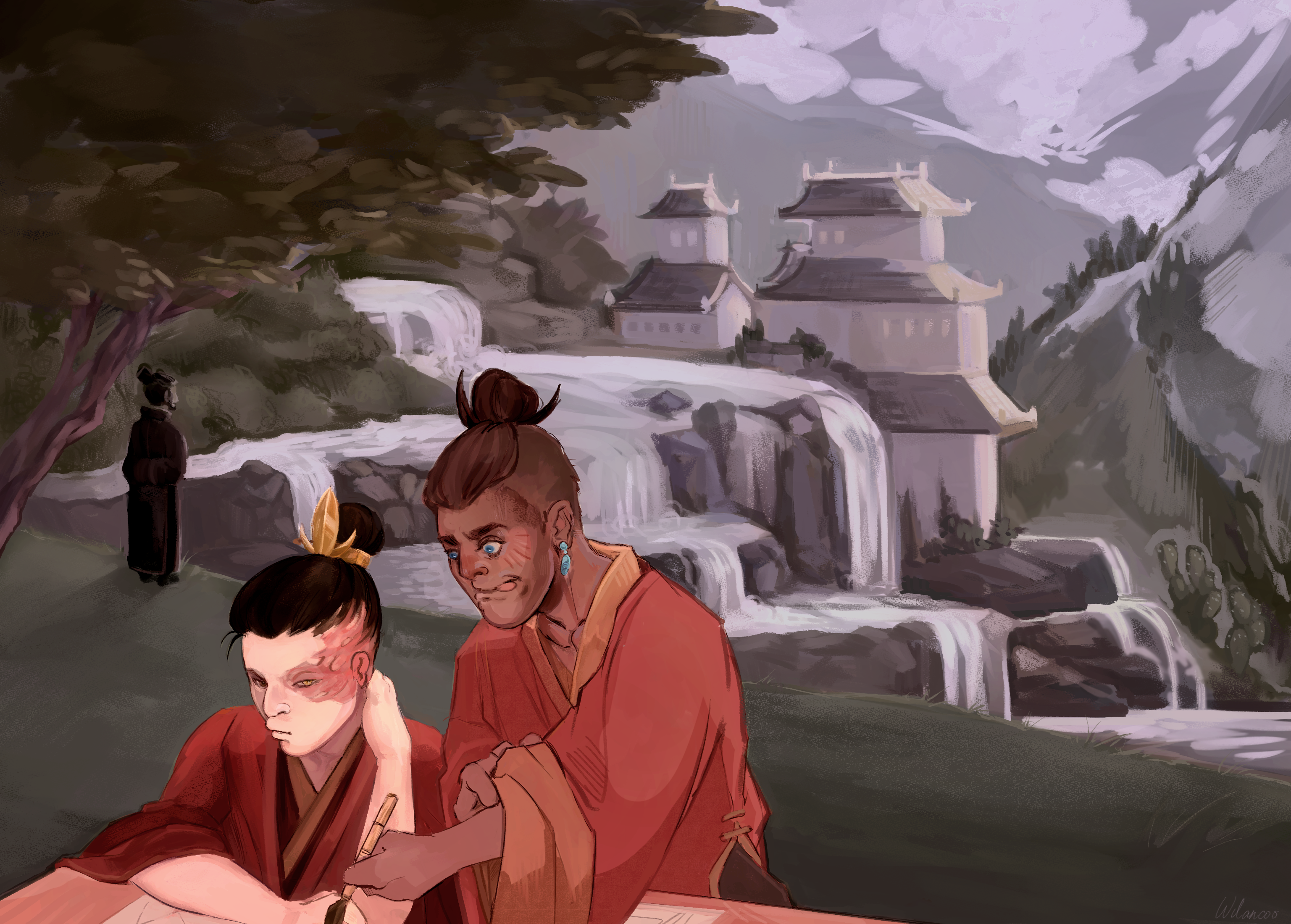
The afternoon brings the “arts,” which on Ideal Student Day 1.5 apparently means hiking uphill until your legs protest, and then pretending to be a painter. Sokka lumbers along the narrow path behind Piandao, careful to avoid the slick stones, catching glimpses of mist threading between pine trunks. The air grows cooler the higher they go, damp and sharp with pine resin, and Sokka’s lungs expand greedily, almost forgetting how much his thighs are burning.
Waterfalls announce themselves before they’re fully visible—first a distant rumble, low and steady, like someone rolling a boulder down the mountain. Then glimpses of white through the trees, teasing him, promising more. And finally…holy—
Sokka stops, boots sliding slightly on moss. He leans on a tree, jaw slack. “Oh,” he breathes. “Okay. Yeah. I get it.”
Piandao glances at him and Sokka chooses to translate it as: And yes, you’re allowed to be dumbstruck.
They set up near the edge—canvases braced, pigments laid out, brushes unrolled with care. Piandao’s instructions are simple: observe. Translate.
Lee appears then, as if summoned by the task set out before them..
He looks… tired. More than this morning. Shadows deeper under his eyes, his movements a touch slower. He takes his place without a word, sets his things down with meticulous precision.
Sokka watches him from the corner of his eye, then looks away.
Fine. Whatever. One less awkward conversation.
He turns his attention to the view.
Which, it really is stunning. The waterfalls fracture the sunlight into a million little sparks. Subtle greens peek out of the dark rock. Mist hangs in the air, catching on pine needles, softening everything. It’s…pretty. Really pretty.
He ducks his brush into the paint again. Focus settles over him, slow and steady. The strokes aren’t perfect—nothing he does ever is—but it feels right. His thoughts quiet down, funnel themselves into shadow, shape, and movement. Time slides sideways. When he finally leans back, shoulders loosening, he notices the grin spreading across his face before he even realizes it.
“Huh,” he murmurs. “I don’t completely suck at this.”
Curiosity sneaks in. Just a glance. Just a check to see how Lee is doing—
Lee’s canvas is almost blank. Not empty—there are marks, tiny hesitant strokes in one corner—but the rest of it is…nothing. Lee sits rigid, brush hovering in midair, jaw tight, eyes narrowing at the waterfall like it personally insulted him.
He keeps lifting the brush. Lowering it. Lifting it again.
Oh.
Sokka chews the inside of his cheek, weighing his options. Should he reach out again? Is it even worth it? What if he gets burned? What if this is one of those “leave me alone, I work alone” moments?
Well. He decides he’ll try. And if he gets burned, fine. No more Mr. Nice Guy after this.
He shifts closer, trying to make it seem like he’s just stretching his legs. “So,” he says, lightly, “this is the part where we’re not supposed to overthink it.”
Lee doesn’t look at him. “I’m not.”
Sokka hums. “Yeah. That’s what it looks like when I’m not overthinking, too.”
That gets a reaction—barely. A flicker of irritation. But Lee doesn’t tell him to go away.
Sokka glances at the canvas, then at the waterfalls, then back again. He keeps his voice easy, teasingly patient, the same tone he used hundreds of times to walk the kids though the intricacies of building ice forts. “You’re trying to get all of it at once.”
Lee snaps, short and tight. “I know what it looks like.” And then he freezes, jaw tightening. “…I know.”
Sokka allows himself a small, inward victory as not getting told to get lost. Okay. Progress.
He squats beside Lee, careful not to crowd him, careful not to trigger more scowls. “Try this,” he says, gesturing vaguely with his brush. “Don’t look at the whole thing. Pick one part. Like—the left cascade. The one that breaks halfway down.”
Lee hesitates, lips pressing together. “That’s not the main falls.”
“Exactly,” Sokka says, leaning just enough to make his point without being pushy. “Main fall is too showy. Distracting. This one’s got character.”
Lee snorts. It’s quick. Unintentional…almost endearing if the kid wasn’t such an ass.
Sokka pretends not to notice, though his eyes keep darting back, watching. The way Lee angles the canvas, shifts his seat, tilts his head ever so slightly, like he’s trying to line something up that never quite settles. His grip tightens. Frustration curls along his shoulders, sharp enough to notice even from a few feet away. Which triggers a thought.
Lee’s adjustments start to make sense, the subtle shifts, the way he leans, the tiny angling of his wrist. He’s compensating for something. Sokka’s chest tightens—not pity exactly. A scar like that…yeah. That would throw off depth, eye alignment, perspective.
He keeps his eyes on the waterfall. “You know,” he says casually, “this light’s kind of brutal straight on. Lots of glare. I had to angle my canvas a bit so I wasn’t fighting it.”
He tilts his own canvas, demonstrating, just enough to shift the perspective.
“And,” he adds, like he’s letting it slip out, “I started sketching the negative space first. Helps trick your brain into seeing the shapes instead of trying to copy the picture.”
Lee freezes. For a beat. Then—slowly, deliberately—he mirrors Sokka’s adjustments. Angles the canvas. Shifts his seat. Lifts the brush again, this time moving. Not perfectly. Not confidently. But moving. And Sokka feels that small, ridiculous thrill in his chest—
Sokka watches for a second longer, then looks away, giving him privacy. He picks up his own brush again. They paint like that for a while.
Not talking. Not enemies. Just two boys sitting side by side, translating the same impossible thing in different ways.
When Piandao eventually calls time, Lee doesn’t look at Sokka—but he doesn’t pull away when Sokka leans over to glance at the canvas either.
It’s still rough.
***
There’s a lull between the afternoon painting session and evening practice, and maybe if Sokka were anyone else he would nap or meditate or maybe read. Sokka, of course, does none of those things.
He has a mission.
***
In pursuit of the mission he might have missed dinner.
***
The forge is quickly becoming Sokka’s favorite part of the day.
Even more so when he shows up with a sack full of meteorite sand (and only lightly dusted with it himself) and sees the light on Piandao’s face—the sharp, manic, focused glow—perfect mirror to Sokka’s soul. The sort of excitement you can’t fake.
They set to work immediately. Piandao organizes the ash, checks the heat, gestures at Sokka like he’s a seasoned apprentice rather than someone who’s mostly winging it. Sokka dives in, heart hammering, hands blackened almost instantly, mind racing through every step: mixing the meteorite sand, setting the flame, getting the temperature just right.
As they process the ash Lee sits nearby, polishing a pair of broad swords Sokka remembers being strapped to his back when he first arrived. He’s careful, methodical, but there’s something almost…reverent. Sokka glances at him, tries not to let curiosity get the best of him, but it’s hard.
Before he gets a chance to ask Piandao asks for his help with the bellows and his hands and brain are full, but his thoughts keep sneaking sideways. Lee. How to get him talking. How to get him to…care, maybe. Blame the boredom, blame the curiosity, blame the fact that Sokka genuinely doesn’t have a ton of friends his own age around here.
Blades. Of course. The swords. Maybe he can start there. Maybe he can make some kind of joke about the polishing, or ask if Lee’s done this before, and if Lee is the kind of kid who…answers. If Lee’s even human, because honestly, the precision and focus he’s putting into this is a little terrifying. And impressive. Yeah, that too.
Sokka’s brain spins a little faster. Maybe this isn’t just about passing the time. Maybe there’s more to learn here—about Lee, about Fire Nation noble kids, maybe even secrets Sokka could actually use. And sure, maybe it’s selfish, maybe it’s nosy, but there it is. Lee looks like a noble kid. About Sokka’s age. Quiet. Observant. Could have knowledge about the palace layout…thought that might be a stretch.
“Are you going to help, Lee?” Piandao asks without looking up, voice calm but pointed.
Sokka blinks. Wait. What part exactly is Lee going to help with?
Lee steps forward, silent, measured, and Sokka notices immediately: he focuses entirely on the fire. Not the metal, not the sand. Just the flames. And with every inhale, the fire pulses, flickers, rises as if obeying him.
Sokka freezes. No. No way. Is…is Lee a firebender?
The realization hits in slow-motion panic. Firebender. The same one Piandao mentioned. The one he hadn’t wanted to identify for Sokka’s own good. Sokka’s brain scrambles. Oh gods. Okay. Okay. Don’t freak out. Don’t freak out. Just—work the sand. Keep your hands busy. Maybe glance at the fire like it’s nothing. Just keep calm.
He tries to focus, watches as Piandao instructs him to start layering more charcoal and iron sand, turning it over carefully. The hours pass in a blur of smoke, heat, grit, and the rhythm of hammering and layering. Every now and then, Sokka sneaks a glance at Lee, whose movements are precise, deliberate, almost ritualistic, like he’s conducting the flames themselves as part of the process.
It’s mesmerizing. Also terrifying.
Finally, hours into the process, Piandao steps back, hands on hips, wiping his face. “We’re done for the night,” he says. “We’ve finished loading all the sand we need.”
Sokka blinks. “Wait. Wasn’t that supposed to take…like, three days?”
“Normally, yes,” Piandao says, amusement barely hiding under his calm tone. “But we have Lee—finest steel maker in the Isles.”
Lee huffs, face unreadable. “It isn’t that impressive.”
“Don’t you have to keep the temperature within…like…fifty Celsius or something?” Sokka asks, squinting at the glowing forge.
Lee tilts his head slightly, confused. “I keep it at the temperature the steel needs to be bright silver.”
Sokka wonders, heart doing that jittery thing again—do all firebenders have this kind of control? This focus, this ability to precisely control the temperature of their flame to such a precise degree? The applications—
Piandao glances at Lee. “Do you want to call it a night?”
“No,” Lee says. “I can sit with it.”
Sokka notices it immediately. The ease between them. Piandao is relaxed, and Lee…mirrors that, sort of, but there’s a subtle difference. He lets something through, a trace of expression, a flicker of emotion, when he’s interacting with Piandao. Not much, not obvious, but enough. Enough for Sokka’s chest to tighten in a weird, confusing way that leaves a pit in his stomach…thought hat might be his stomach protesting just how empty it is.
He exhales, brushing meteorite dust off his hands. “Right,” he shifts, glancing at Piandao. “Uh…Master Piandao, where—uh, where could I…rise myself off? And are there leftovers? From dinner?”
In the early morning, after Fat had come to relieve him, Zuko sits alone in his room, the estate silent around him. His eyes trace the charred edges of the letter in his hands.
The estate is quiet...
There is someone here you might find interesting.
The penmanship is his own.
His thoughts drift back to the sparring from the day before—the way Sokka’s eyes widened when Zuko stopped gauging him, when he stopped holding back. The Water Tribe boy had pressed forward, reckless and determined.
Annoying. Loud. Careless.
And—
Resourceful. Observant. More difficult to dismiss than he wants.
Talent. Raw, unshaped, natural. The very thing Zuko has always had to claw at with discipline, sweat, and frustration. Barely two days of training, and Sokka had already landed a touch on him.
Zuko cuts the thought off, irritation tightening his chest. He doesn’t know what to make of the boy—only that his presence complicates everything. Worse, Zuko’s attention keeps catching on small details he would rather leave unexamined.
Suspicion is easy. Fascination follows close behind.
And beneath both, there is something quieter, wordless—a pull that unsettles him more than either.
Sleep won’t come. Rest refuses him. The urge to act thrums under his skin, sharp and restless.
Finally, Zuko rises. His hand moves to his pack and pulls out the mask.
The Blue Spirit stares back at him, hollow-eyed, patient, waiting.