
Work Text:
☙
Namjoon’s apartment is a graveyard.
Not a graveyard in the sense that it is colourless, or soulless, but in the quite literal definition that it is full of things that are dead. Once, it had been a garden. That’s what people had said at least, anytime they’d walked through the door. Namjoon had never thought of it like that, but rather as an extension of himself, blooming and growing and endless green. It doesn’t look like that anymore.
Still, it’s colourful. Walls and tables covered in the burnished orange and smooth cream of terracotta, the multi-hued brown of soil. There are plants still, too. Shadows of them, bleached almost white, still in their pots. Others are so yellow in their afterlife that Namjoon thinks they may be more vibrant like this, dead.
There are a few that are still alive of course, a snaking green vine that he’d always told the newbies was practically unkillable and a handful of succulents on a windowsill, sun-scorched pink. Sometimes he thinks that it would be easier if there hadn’t been any green left at all. Less of a contrast, just a new colour palette for the apartment, all done up in shades of earth and sun and rust. It might have even been possible, that way, to convince himself that everything was still okay.
He hadn’t wanted any of them to die, not explicitly. It was more that the idea of caring for them, of carrying the water and trimming the leaves and turning them to the sun, had felt so overwhelming that instead he had chosen to hide. Had chosen to hide away in his bedroom where there are fewer plants, and fewer failures.
One by one he’d watched them wilt.
It’s not that he didn’t know how to save them. It would have been easy, even, to bring them back from the brink, to coax and nurture and care for them until they were exactly as they had been, healthy and whole and thriving. More water here, fresh soil there, a harsh but necessary cut back to the stem to encourage new growth. He’s done it before, after long trips or an unfortunate bug infestation, but this time is different.
One morning he’d woken up and stared at the ceiling for eight hours straight, thinking about nothing. That happens to him sometimes, an event he’s always called a grey day in laughing tones to his friends that don’t understand, and in soft, sad ones to his friends that do. They don’t last, typically. A handful of days at most, before he can see colour again, before he can remember what it feels like to care.
But this time one day had turned into three, had turned into five, had turned into months passing in a hazy blur of nothing until suddenly it’s the end of summer and every precious thing that had ever belonged to him has died.
He averts his gaze from them as he moves around the apartment, pouring hot water over a brick of noodles, fridge empty. Not even looking at the floor saves him completely though, because the cheap laminate of his cheap rental is spotted here, there, and everywhere with the dried corpses of leaves. It would help to pick them up, he knows, to at least get them off the ground. It would give him somewhere safe to keep his eyes.
He scans the floor, considers it, acknowledges for the first time in a while that there’s an entire room beyond his kitchen, and a balcony beyond that. It’s August now and if he had been— if he could have—
It’s August now and there should be an explosion of flowers and vegetables on the balcony, planted in spring and coaxed into bloom through the warm months of summer. He should be putting out extras in the lobby of his building, free produce for anyone who wants it, as he has every year before this one. He wonders if anyone has noticed. He doesn’t think anyone cares.
All the balcony holds now is a pile of empty black containers, stacked neatly to one corner exactly as he’d left them the autumn before. In front of the sliding glass door is a large, shallow, plastic container with no lid. Inside are rows and rows of egg cartons, full of soil and the almost-invisible remnants of plants. Seedlings— tiny things he’d grown through the winter under lights and careful heat. A reminder of what should have been. All dead now.
He turns away from them, ashamed, and kicks another fallen leaf out of his path. He’ll clean them up later.
☙
The plants in his bedroom are doing better— in the sense that doing better means haven’t died. They’re scraggly things— a tall spiky one at the end of his bed, a vine with curling leaves on the nightstand, something made up mostly of wide flat paddles hanging from a hook in front of the window. It’s enough though, to keep them green, when he throws the dregs of a cup of coffee or yesterday’s water into their pots.
They haven’t grown at all, at least not in any way he can tell, since he started doing the bare minimum. He doesn’t expect any different. He feels the same, stagnant and just surviving, waiting for things to change. A not insignificant part of himself has started to believe that they won’t, that this is simply how things are going to be forever. If he'd had more energy, that may have worried him.
He’s been reading, he’s pretty sure, to pass the time. The endlessly growing pile of books next to his bed seems to confirm that, but when he looks at the titles on their spines he can’t remember what any of them were about. Some of them look important, treatises on climate and history and politics. Topics he’d cared about, once. Others look like they should have made him smile, romances and high fantasy dramas. Maybe they did. He can’t remember.
Not remembering is a common thing these days.
He gets messages and forgets to reply to them, to the point that most of his friends have stopped reaching out. He doesn’t blame them, but he is grateful for the ones that still do. He tries to explain that he’s not ignoring them, at least not on purpose. Some of them say that they understand. He hopes more than anything that they don’t.
It’s been weeks since he’s seen any of them in person. The ones that say they understand try and invite themselves over, saying things like it’ll be low-key, I’ll bring food, we’ll just hang out. He always says no, deflects, makes excuses. The second any of them get inside his apartment, get the chance to see the mausoleum it’s become, they’ll know. If the garden is a visual extension of his soul then his soul is a desiccated brown, spotted with black at the edges. He won’t let them find out just how deep it runs.
Other times, they invite him out with offers to meet him at his favourite café, or in the park, or at a gallery. Any mention of a gallery makes his heart pound. It’s not something any of them had been interested in before, a clear sign of how desperately they’re trying, that they know something is wrong. Some days, he almost goes. He’ll get so far as to shower and dress, and it’s only while he’s staring at his own face in the mirror that he notices the grey tone to his skin and the circles under his eyes. Another tell, another signal to his friends that screams about just how dry the soil is. Every time it happens, he goes back to bed and invents excuses that he knows they don’t believe.
So, Namjoon doesn’t see his friends— doesn’t see anybody— and instead falls deeper and deeper into himself.
☙
Nobody tends to ask about his plants.
It’s not because they don’t care— even though they likely don’t— but rather because they all know by now that once Namjoon starts talking about them it’s hours before he stops. Each of his friends had come to that realization on their own terms, some with more patience than others. It’s been years since they’d figured it out. Years since they’ve asked.
It’s a surprise, then, when one of them does. how’s that shamrock plant I gave u doing?
It’s an innocuous thing, the question. The plant had been stolen out of a parent’s much larger one and given as a laughing gift after Namjoon had finished a particularly grueling week of finals. It had been one of his favourites. It’s dead now, of course, because almost everything is.
sorry man i killed it lol. As he hits send, he thinks about the choice of the word killed. It feels too active, like it’s something he consciously tried to do instead of something he simply let happen. People tend to understand things that are done on purpose, even when they’re destructive. Neglect, though. Neglect is cruel and passionless and cold. None of the once-alive things in his apartment deserved that. The more he thinks about it the worse he feels, so he tries to stop thinking about it.
He doesn’t want to look when his phone buzzes with the reply, feeling the guilt creep up his neck. It’s one thing to let his own plants die, but something else altogether to fail in the care of something entrusted to him by someone else. A sarcastic, biting, part of his thoughts makes a connection between all of his dead gifts and all of his lost friends. He doesn’t want to lose this one too, so no matter how much he doesn’t want to, he opens the message. u sure? my dad says they go dormant. try giving it more sun
Someone once told him, the first time one of these spells had stretched from one day to three, that if you feel like doing everything is impossible, try doing just one thing and see how it feels. Recently, Namjoon’s one thing has been brushing his teeth. Everything after that has felt impossible, insurmountable.
Right now though, staring at the sans-serif font of the message, Namjoon lets himself think maybe. Maybe if he could save just one, things might end up okay. Things might change. And moving a pot into more sun seems easy enough, a simple task that feels achievable in the face of everything else he doesn’t have the energy to do.
He decides he’s going to try.
☙
The first hurdle comes when he remembers that the best light in his apartment is directly in front of the balcony door. Where the seedlings are. Were. Are. Where what’s left of his seedlings and their soil is. Better.
It causes him almost physical pain to look at them, at all the plans he’d had for them. Cabbage and sweet radish and tomatoes and hot peppers. Grown from last year’s seeds, carefully preserved. He’ll have to buy seeds next time, if he wants anything to grow. The thought makes him nauseous.
He pushes it away, physically, by kicking the plastic container of dead things away from himself, away from the light. It slides for a second until it comes to a stop in front of the couch he doesn’t use. He leaves it there. Doesn’t look at it again.
The second hurdle comes when he tries to find the pot that had once contained his gifted shamrock plant. It’s not that he doesn’t know where it is, because he does, but there’s the remnants of a large-leafed palm covering it almost completely. Another thing that hurts to move, to come into contact with.
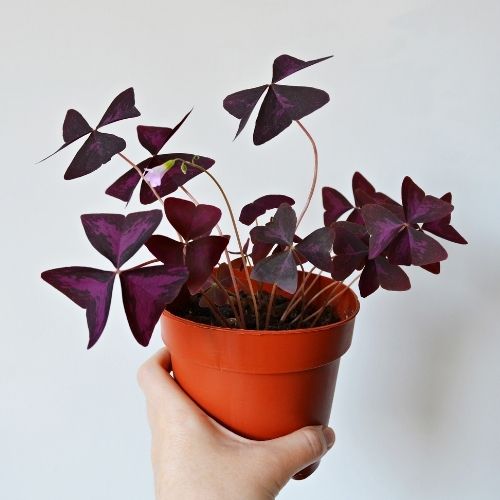
Still, he does, but the planter he unearths doesn’t give him anything approaching confidence that this plant can be brought back to life. The way the individual strands have fallen around the edges of the pot make Namjoon think of bleach-dried hair, straw coarse and frail, even if the battered edges of some of the leaves are still clinging onto the faint memory that they had once been purple.
That’s why it had been one of his favourites. He’d loved the way it had contrasted with the rest of the greenery, with the way its delicate leaves would open and close in the sun like the soft pulses of a butterfly’s wings.
He can see the faint tips of the bulbs at the soil line. Bulbs. He hadn’t realized this plant had those. Had he? He can’t remember. He used to know a lot of things.
Bulbs though, bulbs were one of the first things he was ever taught when he was first learning about plants. About how some things need to go through a period of deprivation, a period of cold or dry or dark, before they can grow again. Namjoon bites at his lip, and thinks maybe.
Carefully, he pulls away all of the dried stalks until nothing is left but the bulbs and the dirt. He throws all the dead things on top of the seedlings without thinking about it. He does think about getting up and going to his storage closet, grabbing a few handfuls of fresh soil so he can bury them properly, the way a dormant thing is supposed to be. Standing and walking the few steps to the closet doesn’t seem that big of a deal, not when he’s so close to the chance of maybe bringing something back, some part of before.
So, he does. He scoops the soil out of the bag with his bare hands, and doesn’t pay attention to the way it gets caught under his nails. Cupping it in his palms, he walks carefully back towards where the pot with the shamrock bulbs is still on the ground. If dirt falls out of his hands and onto the floor, he doesn’t notice and doesn’t clean it up. He packs the soil in gently, carefully, making sure to not press too tight so whatever roots may grow are still able to breathe.
He finishes his prayer with water that he gets out of the kitchen, uses a glass to transport it because somehow, illogically, it feels like less effort than using the watering can. He pours in just a little, relying on a base instinct that he had almost forgotten about, but that has never done him wrong, to judge just how much counted as enough.
When it’s done, he sits on the floor beside it and stares out at what little he can see of the neighbouring building across the street. Someone in another apartment, several floors up and over, has a balcony with every inch of space covered in green. Over the railing, the bobbing heads of a pair of sunflowers dance in the wind. As he stares at them, Namjoon thinks about all the things in the world that need time in the dark to grow.
☙
He goes back to avoiding the living space. If the shallow planter in front of the balcony is going to grow, it’s going to need time. It also isn’t going to need very much more water, at least not until it has leaves. If it ever grows leaves. It probably won’t. Either way, Namjoon doesn’t have to water it and so he avoids the living space.
His life goes back to what it had been before. Every morning, Namjoon gets out of bed and brushes his teeth and goes back to bed. He answers messages hours or days late, and mostly remembers to throw water on the miserable plants in his room. He reads, and then forgets what he reads. He continues like this, grey and formless.
Until, one day, something purple catches his eye in the sea of gold and brown.
His heart almost stops when he sees it. It’s not that he had given up hoping, not that he’d ever really been hoping at all, but some tiny part of himself had never stopped thinking maybe. And now it’s not maybe. Now there’s something there. He puts the kettle in his hands back down on the counter, distantly realizes they’re shaking— just a little. He walks towards the pot, and doesn’t even notice when a dried leaf crunches under the sole of his house slipper.
It’s small, barely the size of his thumbnail, really. But it’s there and it’s open and it’s purple and it’s alive. Something that might be laughter, or might be a sob, bubbles itself up into his throat. He chokes it back and down, but doesn’t stop himself from digging his fingers into his thigh. As he looks, he can see the start of other stems, curling themselves up and out of the dirt. When he sees them, he does laugh, almost hysteric, the closest thing he's felt to joy in months.
Pulling out his phone, he snaps a picture of the single visible sprout and sends it, grinning, with the caption it lives :)
Out of the corner of his eye, he somehow notices that another one of his pots, half-hidden behind the others, is still showing traces of green.
☙
Namjoon’s apartment is a graveyard.
Not a graveyard in the sense that it is colourless, or soulless, but in the almost literal definition that it is full of stone and things that are growing. Once, it had been greener than this, brighter than this. That’s what Namjoon remembers at least, anytime he looks at the pots that are still empty. Other people don’t seem to think so, commenting constantly on how lush it is, how verdant. Sometimes he can almost see what they see, a promise of things to come, a future. Sometimes, that gives him hope.