
Work Text:
Neil was waiting for them as the band filtered off the stage, nursing his good champagne out of a cheap disposable cup. One by one, the Major Crimes filed into the green room, dispensing victory high-fives to each other and the back of house staff, buzzing over “a killer show, man,” the energy in the room, the enthusiasm of the hometown crowd. Neil remained seated on the long, low couch, ankle propped on his knee, watching in silent approval. He bestowed them a proud smirk and raised his champagne. He was greeted with the casual familiarity of an old and beloved compatriot. Drucker threw him a wink, a nod, and a pointed finger. Bosko and Schwartz each shook him warmly by the shoulder as they passed, and Casals bumped his fist.
Vincent Hanna was the last one in, beaming bright as a bulb and sparking like a firecracker, an endless fount of frontman charisma. “Two fucking encores, man!”
Drucker had sensed him approaching and was well prepared. Vincent leaped up on his drummer’s massive shoulders and was caught effortlessly in a piggyback. Drucker promptly carted him over to Neil and deposited him on the sofa.
“You take him,” said Drucker. “I’ve had to stare at his ass all night.”
“It’s a great ass,” said Vincent.
That much was true, Neil thought nervously, acquiescing to Drucker with a pleasant shrug. Tonight had been a good night—one of those rare, uncomplicated occasions for which he had earned the majority of the credit—and Vincent was in a good mood. When he was riding high like this, his enthusiasm was infectious. His exploitations of Neil’s affection for him were limited to harmless hijinks. Neil handed Vincent a cup of champagne from the floor and watched with an eyebrow cocked as he drained the entire thing.
“Thirsty?”
Vincent wiped his mouth on his shirt sleeve and burped. “You have no idea.”
Neil wasn’t worried. These were minor antics. After three stints in rehab a sustainable substance regimen had finally taken hold. Vincent could not reasonably be expected to abstain from the booze and the grass, but so long as he wasn’t putting anything in his veins or up his nose, Neil considered him on the straight and narrow. For rock musicians, you adjusted your standards. Drunken backstage horseplay was boy scout behavior, deserving of a merit badge.
Vincent crept across the faded couch on his hands and knees, a scheming grin on his face. He made himself comfortable in Neil’s lap, an arm slung round his neck, legs crossing over the armrest with a self-satisfied flourish.
“This is a new suit,” Neil protested, but made no move to extricate him.
“He’s blushing!” Vincent crowed.
“Give him a break, Vincent.” The rest of the band had made a beeline for the beers, but Drucker lingered behind to help supervise the circus animal. “He’s the reason we all got cause to celebrate tonight.”
“You think I don’t know that? Neil, I tell this to you all the time, but you’re my hero, man. Truly. I want you to know that. I haven’t played for a crowd like that since ‘93. What was I thinking, swearing off a reunion tour?”
“Not about money, that’s for sure,” Drucker laughed.
“Rock and roll’s not about money,” Vincent sneered.
“Surviving is,” said Neil.
“That’s what we got you for, my Magic Manager. What would I do without you, huh?” Vincent patted his cheek and planted a cartoonish kiss to follow. Neil frowned, but he liked it. “This is gonna be the start of a beautiful new era. ‘As Good as It Will Ever Be.’”
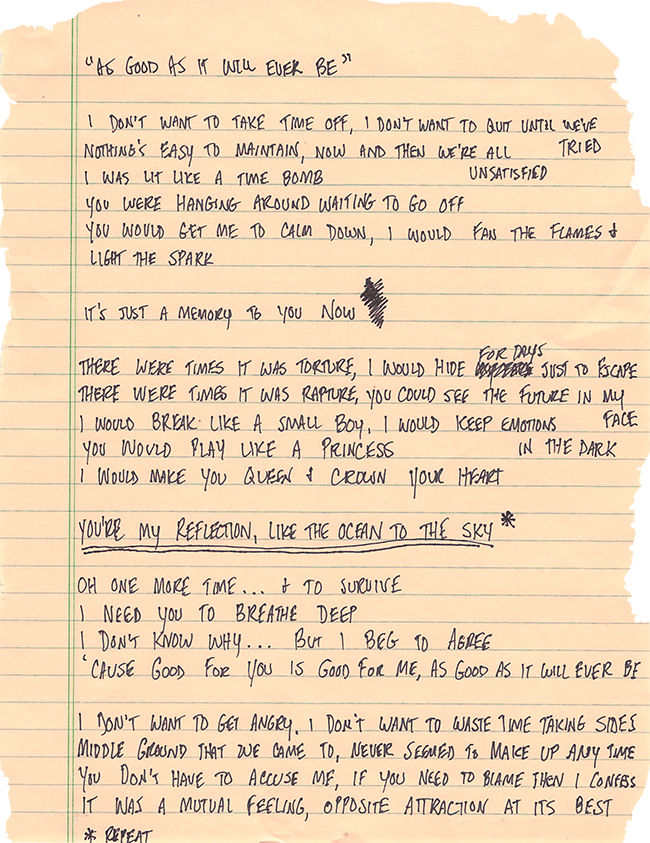
Neil’s ears pricked. He recognized this lyrical extract. It had sounded familiar when he’d heard it sidestage earlier, though he couldn’t place it, and was certain that if Vincent had soundchecked the song in front of him before, he would have remembered.
“Was that the new one you guys played tonight?”
“He noticed!” Vincent lit up like a billboard sign and clasped his bejeweled hands together. “So, what did you think? Be honest. I can take it.”
“I’m always honest. And I think it’s the best thing you done since ‘Turn On The Water.’ I want it on the new record.”
“All-fuckin’-right! The Boss Man seal of approval!” Vincent appeared both thrilled and relieved. Then he jolted abruptly, prickling with excitement. He seized Neil by the collar. “Wait a minute. Who said anything about a new record? You got us a deal already?”
Neil patiently unlatched Vincent’s fist from his neatly pressed shirt. “Blue Room Records and a $120,000 advance.”
Drucker reached down and took Neil’s hand, pumping it up and down vigorously, just smiling and shaking his head.
Vincent gaped in disbelief. “Since when does Blue Room want to spend that kind of money on us?”
“Since Nirvana, probably,” answered Neil.
Drucker, ordinarily quite reserved, was the jolliest Neil had ever seen him. “Since our stone cold negotiator went to bat for us, man!”
Neil had earned his formidable reputation by never settling for anything less than the best. From indie up-and-comers to stadium headliners, he fought tooth and nail for the highest payouts, the most lucrative deals, privileged relationships with promoters and booking agents. He came from nothing, and with nothing but grit and gumption he had built McCauley Management from the ground up. He never took on an artist he didn’t believe in and wasn’t willing to go to the mat for. In the span of a single meeting he could convince a dubious, old-school label exec that a documented liability was in fact a soaring comeback story.
Vincent was no slouch, either—as far as Neil was concerned, a songwriting savant and punk rock lyrical poet. Growing up a precocious runt on the mean streets of Chicago, he’d learned to hide his musical gifts, lest he invite jeers of “sissy” and the occasional schoolyard beating. In high school, boxing classes toughened him up, and by graduation there wasn’t a bully in Humboldt Park who would dare tangle with such a vicious, unpredictable street fighter. But neighborhood brawls were never his passion. College enabled him to finally pursue his compositions in earnest, and after a year of graduate school, he dropped out and moved to L.A. Neil first caught him tearing up the dime-sized stage at Jabberjaw in the summer of 1990, a year before Nevermind changed the fortunes of every American guitar band overnight. He knew instantly that he wanted him. As a client. Fortunately, he and Vincent hit it right off.
Nowadays, the only reason the Major Crimes weren’t packing arenas was Vincent’s artistic allergy to mass market appeal. (Though with his knack for melody, he couldn’t help but score a number of breakthrough hits that still got regular airplay.) Vincent was smart enough to know that a major label deal bought you the resources you needed to produce your most sophisticated work, provided you had the pit bull breed of manager who could guarantee complete studio freedom. Even he didn’t consider it selling out.
“Neil, brother, we owe you big time,” Drucker told him.
“We owe the demos my leather lap cat dragged in. If the songs weren’t there they wouldn’t have gone for it.”
“Me-ow,” said Vincent appreciatively, a little too suggestively.
“I didn’t want to bring it up until I had the draft in hand, but counsel says it’s good. Cherrito called me last night. Let the rest of the guys know we’re due in Monday morning for the signing. 10 A.M.”
“Careful, or I might have to kiss you on the mouth this time,” warned Vincent.
“Try it.”
If only Vincent knew how much he really meant it.
Drucker was lured away by the growing after-party, and the rest of the band went on milling about the green room, making conversation with friends and industry reps, drinking beer and bad wine, picking at folding tables with platters of cheese and cold cuts. With pasted-on smiles, they posed, and Neil would blink and wince from the flash of cameras going off under the grotesque overhead lamps. He hated pictures, preferring to remain invisible, behind the scenes. The spotlight was for his clients. One of the rare exceptions to his distaste for the shutter was on his desk at the office, a faded specimen from a disposable Kodak, perched beside his keyboard in a handsome silver frame. Casals had snapped it in the hallway of the Sub Pop offices the winter of 1991, the day Neil had gotten the Major Crimes their inaugural record deal. In it, Vincent was hanging off of Neil as he had with Drucker, his arms draped around their new mentor’s neck, smashing the first of many pantomime kisses against the side of Neil’s head. The picture was blurry with all the excitement and activity, but Neil’s rare, delighted smile was clear as day.
Speaking of smiles, Vincent continued gawking at him, rapt with drunk adoration. Under torture he would not admit it, but Neil thought the ridiculous eyeliner looked good—somehow even better smeared with sweat. At 40 Vincent was still built like a rail and could rock the tight leather pants, slicked on his lower half like a coat of motor oil. At the moment Neil was terribly distracted by the generous peek of skin between a trio of undone buttons, the inviting angle of his exposed collarbone. Vincent raked a hand through his hair and Neil saw in him now what he’d seen all those years ago, the perfect picture of the rock star reprobate, an instant sell even without the talent—which he possessed in spades. A professional showman and lovable rascal, on stage and off.
As a frontman, his tricks were tried and true. He pulled them out in front of an audience like a rabbit from a hat, in front of Neil with a wink and an insinuating smile. He fashioned disarray into an art form, an alarming and disarming flirtation tactic. It worked like a charm. Grumpily, in spite of a career which should have inoculated him, Neil was as dazzled as the rows of screaming girls. Frankly, he was smitten. Why else would he have put up with all the harebrained bullshit, the low grade emotional torture? Drama and dysfunction be damned, Vincent Hanna was worth the risks, the heartache and the headaches, seven years of chaotic camaraderie. For richer and for poorer, in sickness and in health, in good times and in bad. One of Neil’s many adages was that management was like a marriage, and when you signed with an artist you signed up for the whole demented package. Never let yourself get attached to any act you’d be willing to walk out on when life in the business inevitably cranked up the heat. Neil thrived under pressure. He put in the work to make it work, and no band made him work harder than Vincent Hanna and the Major Crimes. Of his impressively decorated roster, they meant the most to him, more than all the big names combined.
The group took first priority. He’d once been quoted as saying they were the best alternative rock band since The Replacements, a statement he stood by to this day. He believed in their legitimate artistic merit with the same quasi-religious solemnity as their devoted fans. He believed in Vincent, too, for all the trials and tribulations of managing both his craft and his mercurial personality. He considered him a cherished friend. Sure, lately it had been borderline agony to harbor the nature of his feelings in secret, but he wrote the infatuation off to some passing fugue, a temporary amplification of longstanding and hopefully more innocent feelings. Besides, he wasn’t into guys. Wires had gotten crossed somewhere along the line. He’d been lonely since Eady left, and the band getting back together just so happened to coincide with his divorce. It was unfortunate timing, that’s all.
Nothing could come of it, anyway. No chance that Vincent’s coquettish mischief was anything serious; it was all a part of the act, a carryover of the Major Crimes persona. He was like a Stone Temple Stanislavski, perennially inhabiting the role. Nothing personal. Nothing actual. No configuration of the real world that could accommodate for such a far-fetched, stupid fantasy. He could see it now, the headline in Rolling Stone, the episode of Behind The Music, the farcical fanfare like a big joke. If only he found it funny.
Neil would endure. It would pass.
God help him, it would pass.
🎶
The band was due back on the road the following Friday. Neil always caught the local gigs, but it was unlikely he would see Vincent again until the end of the tour. The thought stirred a covert gloom just short of despair. He was determined not to let it ruin the evening’s success. When the backstage libations wrapped up, Neil called himself a company car back to his pad in the Hollywood Hills. As was customary, he offered to drop Vincent off en route.
Vincent was unusually quiet for much of the ride, gazing out the tinted windows with his chin in hand, downtown L.A. sliding past in an electric amber gleam. Neil knew Vincent didn’t much like being on the road. It was mostly drawn-out drudgery, crowded airports and cramped tour buses, a lot of standing around with your thumb up your ass while you waited for the short-lived euphoria of the stage. Every group got sick of it sooner or later. With the exception of Vincent, whose ex-wife and stepdaughter were on decent if distant terms, the guys had families they were reluctant to leave behind. But everybody was back to getting along, now, and families cost money to support.
Neil got the sense that something in Vincent had shifted, subtle on the surface but substantial underneath. At first he thought it was the band regrouping—who’d seen reconciliation coming?—or maybe the belated growth spurt into a sober, more sensible maturity. He was getting older, less enchanted by the temptations of cult stardom and critical attention, the exhausting endless playground of indulgence and excess. But there was something else to this newfound, pensive character. He wished he could understand what it was. He wanted this reconnection to stick, and though they’d stayed in touch after the Major Crimes first called it quits, the distance imposed a gradual drift. He missed when the two of them were joined at the hip, even if it was often through a Vincent-shaped thorn in his side.
“Spin’s doing a big piece on ‘frontman iconoclasts,’” said Neil, grimacing at the phrase. He was trying to make conversation the only way he knew how. “They want an interview. What do you want me to tell them?”
“Depends. Who else is in it?”
“So far, Billy Corgan, Michael Stipe—”
“They must be confused. I still have all my hair.”
“—Raine Maida, Thom Yorke—”
“And my range is nowhere near that high.”
“Come on. You’re in solid company. And they’re doing a photo shoot. They’ll fly you out, pick your brain, take some pictures. Wine you and dine you for a couple of days.”
“Well, when you put it that way . . . ”
“It’s not so bad.”
“Fine. What the hell. Beggars can’t be banquet choosers.”
“Good. I’ll let them know. Try to be nice.”
Vincent shot him a flinty look. “I’m only nice to you.”
Neil’s eyebrows said that was debatable, but he couldn’t be bothered to argue. It was important to remain focused on the core takeaway, the bottom line. “It’s good press. This is a renaissance phase for the band. You need a narrative.”
“I thought that all press is good press.”
“Which asshole told you that?”
“I don’t know, it’s an adage. You like adages.”
“Not if they’re a load of crap, I don’t. Look, you may not give a shit, but I do. It is my job to give a shit. I don’t need you picking fights with Perry Farrell or gettin’ handsy with supermodels right in front of the paps. Most of all I don’t need you scoring junk on some South Central street corner.”
“Neil, I haven’t touched the stuff in almost a year and a half.”
“I’m gonna need you to stay outta the hospital and in the respectable rags. Spin, AP, CMJ—”
“I’m a musician. I play rock music. ‘Respectable’ is a tall order, arguably antithetical.”
“Yeah? Well for the sake of my arteries, give it a shot.”
“For you, baby? Anything.”
Vincent called him “baby” like it was nothing. He was a musician, he played rock music, and his vocation gave him license to just throw that word around, no big deal. Neil was forced to cope with it, to cross his legs or bite his lip and fume in silent torment. He swallowed.
“Look, if you want, while you guys are on the road, I can set you up with—”
“Oh, Neil,” Vincent sighed, practically thespian, reaching over and grasping Neil’s fingers on the seat between them. “I don’t want to talk business with you, I’m sick to death of it.”
“OK,” Neil said uncertainly, staring blankly at their joined hands, at a loss so profound he could muster no comment. Best to ignore the gesture entirely. “Do you not want to talk?”
“I always want to talk to you. About anything else. About life. About art. Hell, about you. The shit that matters.”
Neil choked down his retort, mystified by Vincent’s flippancy with respect to his own livelihood. Vincent outsourced such pedestrian concerns, or else dispensed with them wholesale. At least at present he wasn’t sampling the chemistry set, scrambling his brains, casually poisoning himself with an assortment of pills, blow, and speedballs. Financial apathy was the least of his problems.
“I really did dig that new song,” Neil tried with an encouraging shrug. “I was not just saying that.”
“I know, you never lie to me. For better and for worse. That’s why you’re good at what you do.”
“You said you didn’t want to talk business.”
“It’s also why you’re a stand-up guy.”
“So are you when you’re not using.”
“Flattery will get you everywhere.” Vincent joked, but his face twinged with something buried and almost pained. His eyes traced a sultry up-and-down that made Neil’s stomach do roller coaster maneuvers. “But it’s not a new song.”
“What?”
“It’s an old song. Very old. From the Dead-Tech Bullshit discard pile, in fact.”
Neil couldn’t help but feel a flare of real annoyance, industry indignation. He couldn’t turn it off. “Are you outta your goddamned mind? The discard pile? That shit is ready for radio! You’d land on fucking KROQ in less than a week!”
“It was too personal.”
Neil groaned and clasped a hand over his face.
“Even tonight, I wasn’t sure if I was ready for you to hear it.”
“What the hell are you talking about?”
“It’s about you and me.”
“Oh, give me a break. Quit pulling my chain for once.”
“I’m not. Cross my heart and hope to—”
“Don’t you dare finish that fucking sentence.”
Terrifyingly straight-faced, Vincent signed over the wreath of gaudy necklaces stacked on his chest. Neil tried not to stare into the gape of that plunging neckline again—Jesus, had he undone another button on their walk to the car? His own heart was starting to pound, slamming at his ribs with a vengeance.
“I don’t believe you,” he said levelly.
“Why not?”
Neil gestured uncomprehendingly with his hands, trying to summon sense from the air. “It’s a . . .” The words a love song would not leave his throat. “I mean, come on, all that shit with the princess and the queen and everything? It’s about a girl!”
“Oh, Neil, come on, man. I was covering my ass! Every rock song’s gotta be ‘about’ a girl, you know that better than anybody. I mean underneath. The heart. The soul. What I was thinking and feeling while I was writing it.”
Neil couldn’t tell if he should be relieved or heartbroken. “So it’s just a metaphor, then?”
“Neil, you’re killing me. How much more explicit can I possibly get? ‘You’re my reflection, like the ocean to the sky.’ I spend the night all over you and you just sit there like a grouch with that wounded animal look—”
“Wounded animal!”
“—and now here I am, laying myself bare in this spacious luxury vehicle, ‘cause I figure it’s the last chance I get before I don’t see you for eight weeks. Maybe it’s the last chance I ever get.”
“I don’t know what you’re saying.”
“For a smart guy, you really are dense. Here. At tremendous risk to our personal and professional relationship, allow me to make myself abundantly clear. How’s this for a metaphor?”
Vincent clicked his seat belt off and once again, Neil had a lap full of him, straddled around his waist this time. Neil looked him up and down in flustered consternation, hands floating uselessly at his sides, throttling the urge to sink his desperate clutching fingers into the flesh of Vincent’s thighs. He nearly blacked out from the effort. His heart was hammering like a double kick, double time, going hard enough to bust clean out of his sternum. Below the belt, a more dire problem was beginning to present itself. The wind was blowing in through the cracked window, rustling Vincent’s hair like a television commercial, but the temperature in the car was suddenly a thousand degrees.
“Why, hello, there.” Vincent’s expression was sly, but his voice was soft. “Glad to know I wasn’t just gambling on a wing and a prayer. You’re a lot better at hiding your emotions from the shoulders up. You always were the strong, silent type.”
Suddenly, it hit him. Neil remembered. That dreadful night in September of ‘95 when Vincent had relapsed and OD’ed. It was two in the morning when the shattering wail of Neil’s bedside telephone had roused him from an unusually deep sleep. He had never gone from half-conscious to wide awake so quickly as when Vincent’s voice filtered through the handset. The sharp wit and silver tongue had slowed and warped like a damaged tape reel, almost unrecognizable but for the warm, smoky rasp of that distinctive tenor. He’d called Neil instead of the fucking ambulance.
It was Neil’s worst nightmare. He phoned 911 in a panic and drove to LADMC like a bat out of hell, still in his pajamas. Mercifully, one of Vincent’s many prodigious talents was weaseling his way out of the worst kind of trouble. By some miracle, he was alive. He’d escaped death by the skin of his teeth—by a matter of minutes, according to the attending physician. Neil was overwhelmed with relief and chilled by the sight. Vincent bore a harrowing resemblance to a corpse laid out on that gurney, white as a sheet and soaked in sweat. He looked like a drowning victim hauled up from the depths. He was motionless, cold, barely breathing.
Neil was so shaken by the ordeal he hadn’t even thought to be angry until after, when Vincent was stable and alert, looking sorry and sheepish from the narrow hospital bed. His was a slight figure, but with the IV lines and oxygen tube running out of him, his appearance was positively frail. It was the only reason Neil kept the lid on his explosive temper and didn’t lay into him, settling instead for the blazing stare he usually reserved for incompetents and insubordinates. Outraged as he was, he rooted himself in the uncomfortable bedside chair and refused to leave. The staff made no attempt to send him off. This was not Vincent’s first rodeo, and Neil had been informed that he was listed on Vincent’s chart as both emergency contact and next-of-kin.
Hours later, with dawn finally breaking over the hills, Vincent had rolled his head very slowly on the stiff little pillow, as if to do so required enormous effort. He gazed imploringly at Neil and asked, with meek and uncharacteristic deference, “if it was still good” between the two of them. Stonily, not wholly certain himself what he meant by the answer, Neil had said, “As good as it will ever be.”
“You can’t tell me that all this time . . . ”
“Yeah. All this time. I got it so bad for you, Neil, baby. I always have.” Vincent ran his palms up the breast of Neil’s jacket. The trickster had vanished, and his face was serious, devastatingly honest. “So now, you tell me. Tell me that you give a shit. And not because it’s your fucking job.”
The farthest reaches and deepest gutters of his imagination had never accounted for this. It had not registered as a possibility. There was an inferno raging in his groin, a frantic lovesick need twisting inside his chest. The heat frothed and burned and boiled over when Vincent leaned down and took Neil's face in his delicate hands.
Neil surged up into him, kissing him with the volcanic fury of years of pent-up lust and pressurized longing, clawing through his hair, at his tight little ass, grinding his historic hard-on into the crotch of his designer pants. Vincent’s shameless, melodious moan was worth the possibility of their poor driver getting wise to the action. The steamy, salacious make-out session going down in his back seat was one for the record books.
Neil tore down the remaining row of buttons and Vincent held his shirt open obligingly. Grunting hungrily, Neil sucked a trail of kisses down the hollow of Vincent’s chest, taking deep, voracious breaths of his bare skin, the spicy, savage odors of sweat and sandalwood, enjoying the sweet music of sighs and whimpers sounding from up above his head. Vincent was gyrating on him like a porn star, rolling his hips, rocking against his thigh, humping his leg with helpless abandon. He said “oh baby, oh baby” in strained whispers, repeating it like an incantation, a delicious dirty spell. Neil was getting to like the sound of it, now. He wanted to dial up the volume on that refrain. He wanted to hear Vincent calling his name loud and clear, forget endearments or epithets or song lyric substitutes, hollering with ecstasy until the house came down.
The frenzy screeched to a halt when the car rolled to a stop. They unlatched and hung there in awkward suspension. Vincent’s lovely face was striped scarlet, flushed with vigor. The white flesh of his heaving chest was patterned with stubble burn and the rosettes of fresh hickeys. Neil glanced down at the dark blooming stain on his trouser leg and was relieved he couldn’t see his reflection in the rear view mirror. He didn’t care what happened to the suit anymore. He wasn’t sure he ever really did.
Vincent turned his head to the window in dismay. Neil followed his attention to the dark, quiet street and saw the familiar asphalt path curving up the scrub-lined hill to the house. They were parked in front of Vincent’s driveway.
Neil’s hand shot out and latched the door.
Vincent’s head snapped back to Neil.
“Keep it moving,” Neil called to the driver. His eyes were locked with Vincent’s.
“Yes, sir,” came the dampened voice through the partition.
Vincent’s face was alight with ferocious glee. Neil smiled back, as big and bold as the photograph.
“Let’s go back to my place,” he said.
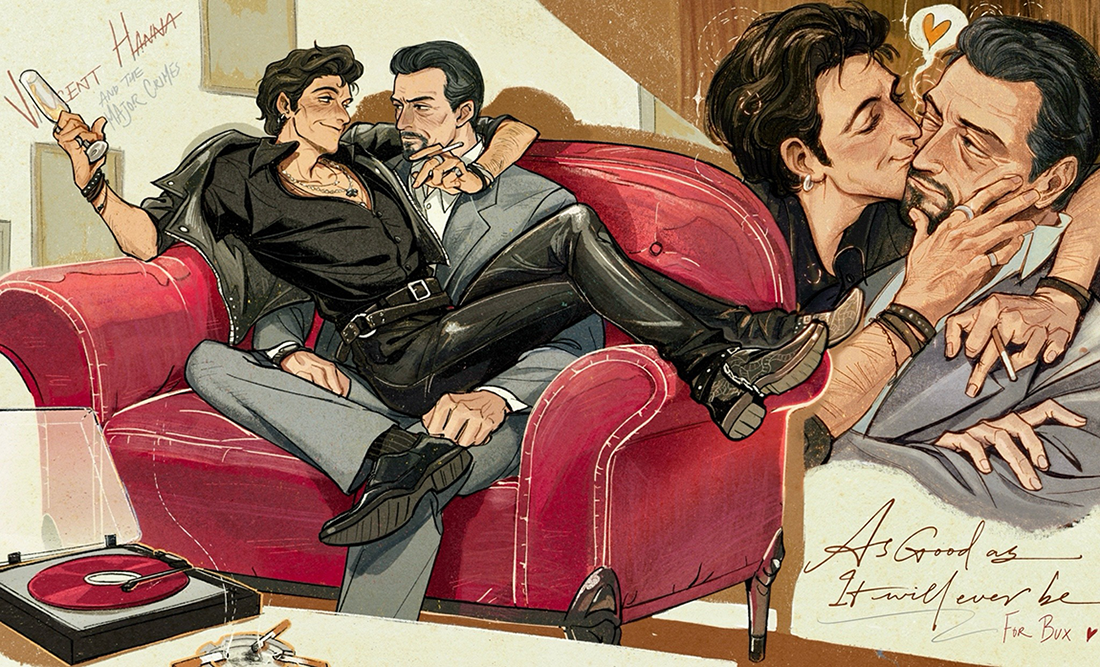
Fanart by the supremely talented and wonderfully generous @san-hun-po on Tumblr/X!