
Chapter Text
Stede thought moving into what the guidebooks called “the heart of the gay-borhood” meant he’d find—something. Honestly, he’s not sure what. But whatever it is, he hasn’t found it yet, not in the three months he’s spent in his new condo.
But the problem with moving halfway across the metro area to get a fresh start? Is that you always take yourself along for the ride. He still feels like he’s fluttering over the ground like a tumbleweed, not able to put down roots. He’s just... existing, in a different spot than before.
At least he doesn’t have Mary giving him that disappointed look from across the table every night here. And now that the kids aren’t at home—Alma at college on the west coast, Louis at boarding school in his last year of high school in Connecticut—he’d be sitting at the same quiet meal in Greenwich as he is in Greenwich Village. But at least here, he’s doing it on his own terms. And here, the takeout is significantly better, too.
He finishes his shawarma plate, rinses the foil container, and tucks it in his recycling tub. It’s still light outside through the big plate-glass windows that frame his view of Jersey City and the Hudson.
It’s a beautiful view. He’s spent a lot of time contemplating it, these last few months, from his lovely green wingback chair, a cup of tea in hand. He’s not directly on the river, but he’s high enough up a few blocks away—he’d chosen a condo on the seventeenth floor, wanting the airpace, the aesthetic of it—that he can see over the buildings and into the sparkling expanse of blue-grey. If he turns just right, he can even see down into the wider water where the East River meets it at the tip of the island.
He doesn’t sit this time, instead stepping close to the window, nearly touching it. He can see straight down to the sidewalk across the street, the cute little shops he’s ducked into a few times, and the crowds of people surging across when the signals change. Faintly, he can hear the rush of traffic, and, below that, he imagines he can hear the woosh and screech of trains underground.
Suddenly, Stede can’t stand being in the apartment another minute. He’s been inside nearly all day, been trapped at his computer doing his terrible remote job that he’d kept when he moved out, moving money around in useless circles, making the numbers go up like the piercing note of a finger around a champagne flute. He hates it. He could probably quit, live off the money in his various accounts, but the idea of quitting is—unnerving. What would he do?
He has to get out of his condo before he rots like a sad old log. He has to.
He pulls on his teal peacoat—warm, wool, dazzlingly bright, Mary had hated it from the moment he bought it—and shuts the door firmly behind him.
When he steps out onto Christopher Street, he immediately feels better. The autumn sun is warm on his face where it cuts low through the buildings and turns the granite foundations sparkling. The bricks of the buildings shine in the golden light, and Stede should have done this hours ago, should have left his empty condo and come out here, among proper city folks.
He pops into a couple of shops, buys a ceramic owl figurine, a box of chocolate-covered cherries soaked in liquor, and a lovely ring topped with a gorgeous polished chunk of turquoise that seems to glow with an inner light.
His mood sets with the sun, though, and he finds himself in the little triangular park tucked between two busy streets, the one he can just see the tip of from his bedroom window. The sun has slipped below the line of the buildings, and the temperature is dropping with it. The park is green, and quiet, and somehow peaceful, despite the bustle all around. He’s not sure how he never noticed it before, only a few blocks from home, but he’s grateful he has.
Stede’s tired: his neck is sore from a day hunched over a keyboard, his eyes are strained from staring at a monitor, and he fancies that his very soul is tired from—existing, from the Stede Bonnet of it all.
He sits on a bench and leans back, tipping his head up towardthe darkening sky.
In a city of eight million, he’s all alone.
(In a world of eight billion, he thinks, with a bit of a sardonic internal chuckle, he’s equally alone.)
#
He comes back to the bench, almost a daily ritual now. It’s somehow an island of quiet in the sea of noise—and don’t get him wrong, he loves the bustle, loves the hubbub! But sometimes when he takes his evening walk as the sun sets, he needs that moment of peace.
The sunsets are coming quicker as September creeps by, and the first time he’s walking into the park later than usual, just as the streetlights flick on, he very nearly screams.
There’s a shape above his bench. A huge shape, dark and ominous, covered in hair, glowing eyes and—
Oh.
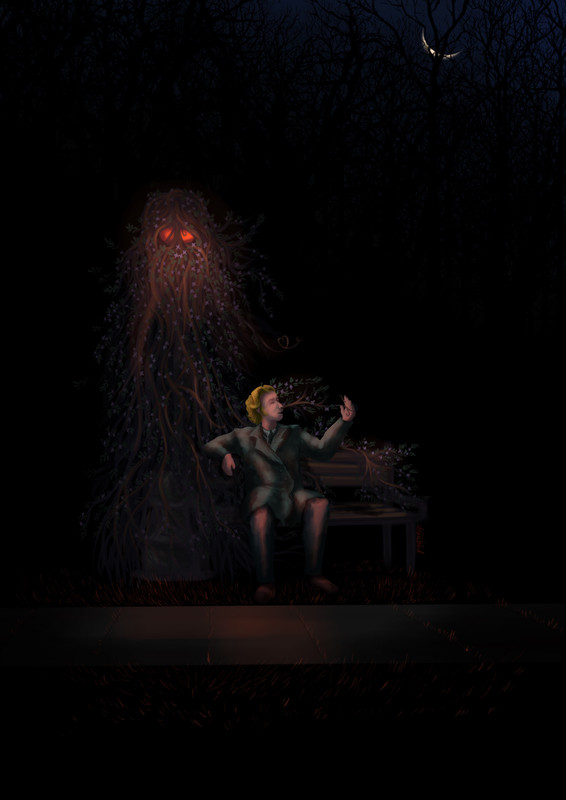
It’s a streetlight. It’s been overrun with vines of some kind, foliage thick and dark in the dusk, and the glowing eyes are just the lamp shining through the branches.
Stede feels a little silly, but he hesitates a bit before stepping closer.
It really does look like a being of some kind. It’s nearly ten feet tall, vines dangling down like limbs and a beard, tree trunk and lamppost tangled somewhere in the wild tumble of branches. It’s menacing, certainly, and at the same time—melancholy.
Stede huffs a laugh to himself as he settles on the bench under the glow of the lamp and breathes in deep. The park smells nice tonight, almost floral, and it’s a lovely change from the exhaust-and-hot-dog smell of just outside the boundaries of this little triangle. The vines above him rustle, and it almost feels like company.
“Well. What a lovely night,” he murmurs. They’re the first words he’s spoken today, but it’s not like anyone will hear them anyway. There’s no one else nearby; it’s a weekday and he’s sure most people are settling in to have dinner with their families and loved ones. No, no one else, except the humanlike plant beside him.
“You already know that though, don’t you?” He directs his question to the vines. “Lots to see from here, and what a wonderful spot to watch the sunset!” And yeah, sure, he’s talking to a plant but it somehow eases that ache in his chest, if only a little bit.
He’ll take it.
#
Stede finds that talking out loud, talking to the tree, helps. Yeah, he’s still living alone, still chained to the desk in his study, but for 45 glorious minutes every day, he feels like he has a little bit of company.
As autumn progresses, the night falls quicker, and it’s not long before Jeff—he decided the tree, with its almost preternatural presence, needed a name, and it looks very much like they could be a Jeff—anyway, it’s something special to see Jeff’s eyes light up with their otherworldly glow as he’s striding up to the bench rather than just before he stands up to leave. Their light doesn’t stretch far—the nearby trees bright with orange and golden foliage in the daytime reflect only deep ochres and muted grays this time of night—but it’s just enough for Stede to see, just enough to pretend that the looming shape next to him is a friend, someone he can confide in.
Jeff’s a great listener. That first day, Stede doesn’t get much farther than those few pleasantries, but in the days that follow, he finds himself opening up. First about his job—the stress and overwhelm from a hellish week comes pouring out of him. Soon he’s talking about his ex-wife, his kids, his childhood, the horrible days of living under his father’s thumb. It feels good to get it all out in the open, even if it’s only to a human-like mass of overgrown branches. Soon, all his secrets are tangled up in Jeff’s vines, his hopes, dreams, and fears intertwined with every tendril. Jeff doesn’t feel like a pile of branches anymore—he feels like a friend.
Shit. Stede has got to get out more.
#
After one overwhelming workday that capped a grueling week full of deadlines and meetings and emails upon emails, Stede finally makes it to what he now considers his bench feeling frazzled and worn thin. He sinks down onto the seat and immediately, horrifyingly, bursts into tears. He buries his face in his hands and lets his body collapse onto the warm wood of the bench.
It’s been a day. It’s been a week. It’s been a lifetime, honestly, and he’s not—he can’t—
It’s been a lot, is all.
“I thought,” he says, taking a deep, shuddering breath, “I thought this would fix everything.” He gives a little laugh. “Of course it didn’t. Of course it won’t. It’s exactly the same as before, only I’m even more alone now.”
There’s a rustle behind him, branches in the wind, and Stede slumps down further, tipping his head back against the bench.
Something brushes his shoulder, and he stiffens, flinching back—but it’s just a tendril of vine, shaking in the wind. He relaxes again and closes his eyes, taking a deep breath. The vine moves again, brushing over his shoulder, then, almost tentatively, his cheek.
It’s a nearly human touch, warm and soft with curled, fresh leaves. “Thanks, Jeff,” he whispers, and somehow, he feels better.
#
The winter is long and cold, and for nearly a month, his bench is unreachable, buried in gray drifts of snow that Stede can’t quite bring himself to cross in his nice suede boots. So instead he wanders the paths in Washington Square Park, and it isn’t the same.
“You should get a dog,” Alma says when she and Louis Facetime him one Sunday afternoon. “Something to keep you company, Dad.”
“What about fish?” Louis asks. He’s twirling in his desk chair, the camera view spinning just slowly enough to make Stede slightly nauseated. “Nice tank of fish, Dad? You could get all the colorful ones, get weird with it.”
“I don’t need a pet,” Stede protests.
“I dunno,” Alma says dubiously. “I mean, what you need are friends, adult human ones—”
“What I need,” says Stede, because this is getting embarrassing, he’s the parent here, not his 21- and 16-year-olds, “is to hear about how you are.”
He gets Louis talking about some computer game involving primates and weapons, and counts that as a success. Still, when Louis leaves the call after his dorm parent knocks to let him know it’s time for lights out, Alma sticks around just another moment.
“Seriously, Dad,” she says, and Stede can see it in her eyes, the concern, the adult-ness she’s gained in the last few years shining through, “I could come visit sooner, if you wanted?”
“Don’t worry about me,” he says, because he knows she’s only saying it because she’s concerned, knows she’s busy with school and her job and her own friends, “I’ll see you this summer. I can’t wait. I’m fine, Alma.”
She doesn’t look convinced.
#
In early March, he wanders by the little park and the snow is all gone, finally, melted away like it never was. In the corner of the entrance, just below the gate hinges, tiny specks of white and green are bursting forth. Stede kneels, not quite letting the knees of his pants touch the ground, and brushes careful fingertips along the leaves of the little snowdrops peeking out from the edge of the gravel. The park feels like it’s vibrating, just a bit, with the restrained life ready to burst forth, and when Stede reaches Jeff’s bench, he lets out a breath he didn’t know he was holding. The streetlights are already on, despite the way the nights are already trending shorter, and Stede’s glad for the familiar silhouette.
“Hello, there,” he says quietly, coming to a stop in front of the bench. “I’m back.”
The plant doesn’t reply—obviously, because it’s a plant—but Stede lets himself imagine that the vines are swaying towards him, tendrils unfurling, leaves stretching. He settles on the bench, leans back, and shifts until his arm is stretched out along the planks of the bench’s back. The breeze feels good on his face, on the cotton of his shirt where his jacket is unbuttoned, and the soft, new leaves against his knuckles feel almost like a caress.
He starts slowly, haltingly—talks about work, the kids’ sweet but slightly patronizing concern for him—and the sounds of the city around him feel somehow like they’re listening, like they’re holding his words, soothing them, keeping them safe. He sits until the moon is high in the sky and the spring wind turns cold, before rising with a wince and walking the few blocks back to his condo.
He sleeps better that night than he has in months.
#
The following day is terrible. Just—just awful, especially compared to the peaceful night he’d had. His job isn’t complicated, really, and it isn’t important to anyone except the people whose money is growing in the little boxes on his screen, but there’s a fluctuation in the price of cocoa after a financial disclosure and—well. It’s incredibly boring, but it had led to meetings upon meetings and endless screaming conference calls, and Stede had missed his lunch and also three calls from Louis, who had then texted, when Stede called back, to say that Doug had handled it.
Doug. Stede wishes he were less boring, so he could hate the man. Mary, for all her faults, is at least an interesting person underneath it all: what she sees in Doug he has no idea, except that he’s the opposite of everything Stede is.
That evening, he finds tears rolling down his face as he relays this all to Jeff. He sniffles into his handkerchief, wiping up the worst of it, and settles back into the wooden panels. Before he can take another breath he feels a tickle on his left shoulder that startles him into sitting up again. Twisting around, he spots the culprit and finally lets the air out of his lungs.
“Oh, it’s you.” For the first time that day a smile hints at the corners of his mouth. A bit of the winding tendrils from the vine have worked their way across the top of the bench, curling up and around where he’d normally rest his shoulders. It’s another odd, comforting moment, another little bit of fantasy that delights something in his core.
He sits back, breathing easily again, idly twirling the curly fresh shoots between his fingers. “Sorry. It’s been a hell of a day.” He smiles, just a little one. “And, to be honest, I really missed coming here to see you.”
On a whim, he wriggles the new, turquoise ring off of his fourth finger, slipping it on a dangling vine. It looks nice there, sweet and shining, and Stede figures it’ll be stolen soon enough. “This is for you,” he says, tipping his head back to look up into the tangle above him. “To thank you. For being here for me.”
The leaves above him rustle, and he imagines the light going a little brighter, then dimming again.
#
Stede’s routine is different, now that spring is here: the park feels strange and empty in the daylight, so he takes to doing his walks later and later. He brings a book, sometimes, reads poetry or romance aloud quietly. And yes, he wonders, sometimes, if it’s strange that a mass of foliage is the closest thing he has to a friend here, but—
But it makes him happy. It feels better, in this place. He knows it’s some kind of magical thinking, that the plant is listening, that it cares for him, that the brushes of twigs and vines over the back of his neck and through his hair are purposeful rather than the random motions of the wind. But somehow, he feels less alone.
Or, actually—
Oh, fuck, he thinks. No, he’s not alone. Not tonight.
Something snaps: a twig, maybe, and Stede’s heart jumps into overdrive a moment before he spots it: there’s a man stalking into the park, moving quickly, and he’s headed right for Stede.
His footsteps crunch loudly on the gravel of the path, and when he meets Stede’s gaze, his eyes flash with anger.
“Bonnet!” he yells, and Stede’s heart speeds up in an instant at the venom in the words. He shrinks back against the bench, book clutched in his fingers, and quietly panics.
“Bonnet! You utter imbecile!” The man reaches him, and when the light from Jeff’s lamp bounces off his flat, straw-blond hair, Stede recognizes him: Nigel Badminton. The client with the cocoa farm investments.
Fuck.
Stede pushes himself to his feet, backed against the bench, and when Nigel’s arm rises between them, there’s a gun clenched in his fist, and then—
Well. Stede’s not quite sure what happens.